
Sep 15, 2026
IBA vs NAA vs IAA: Which Auxin for Rooting and Fruit Set?
Related products
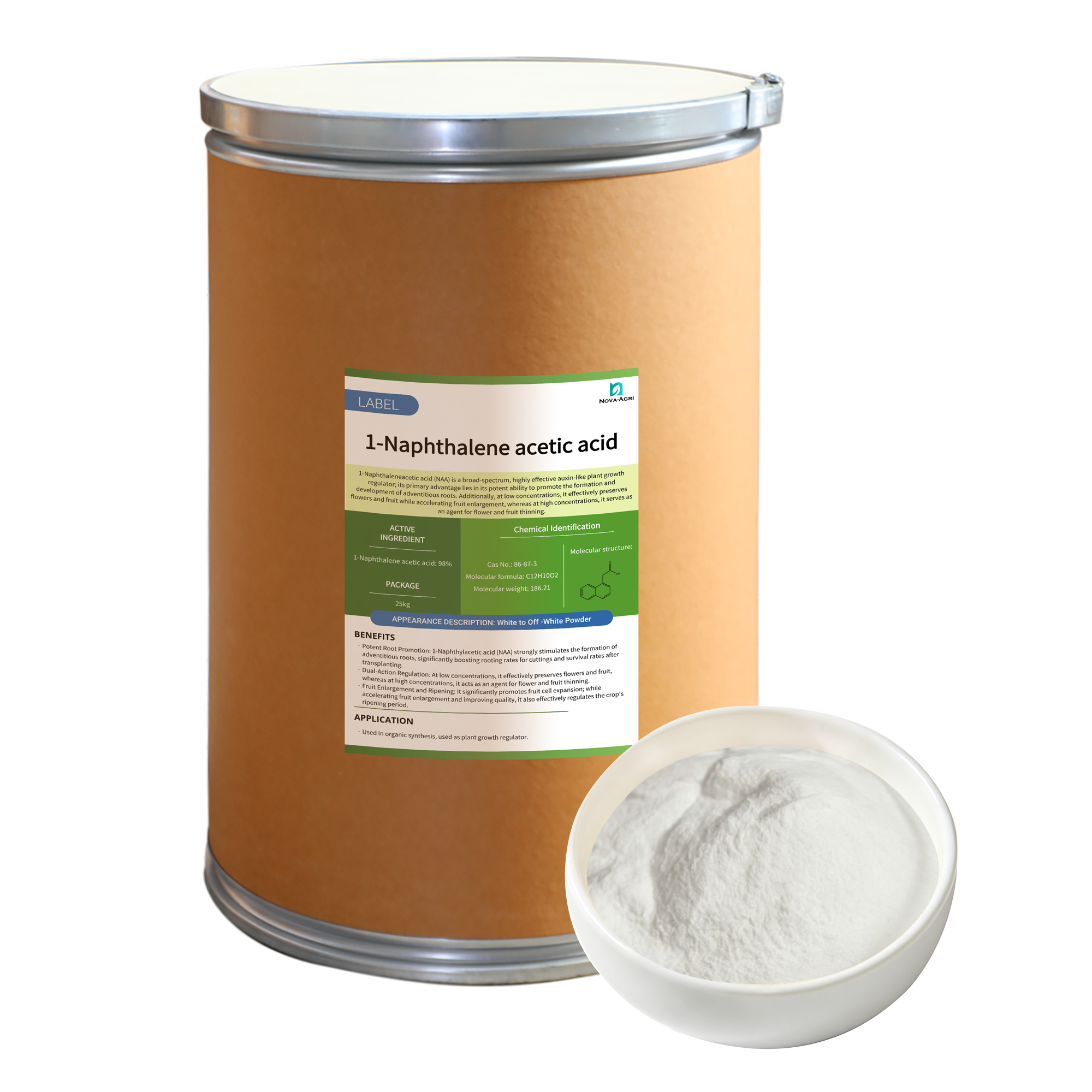
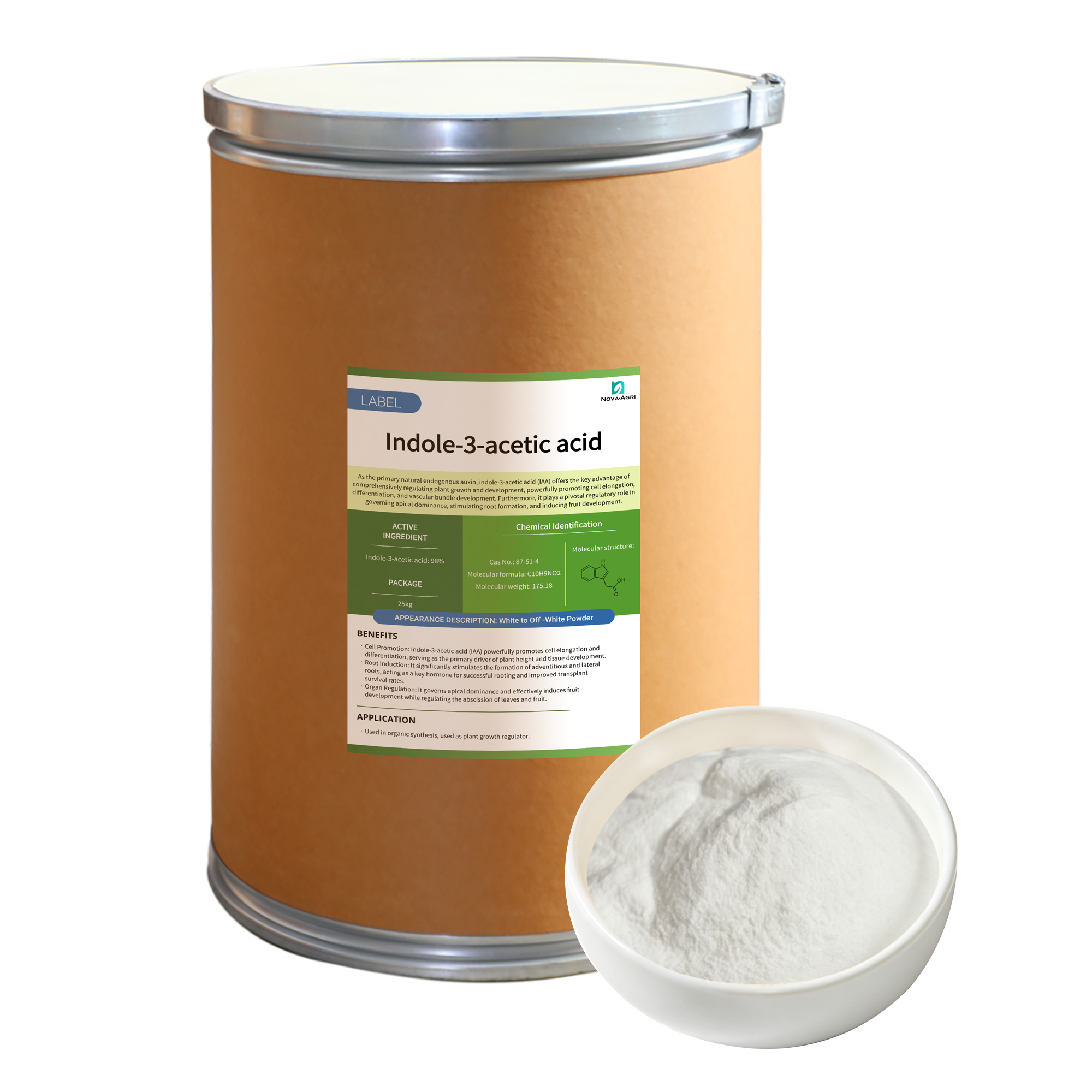
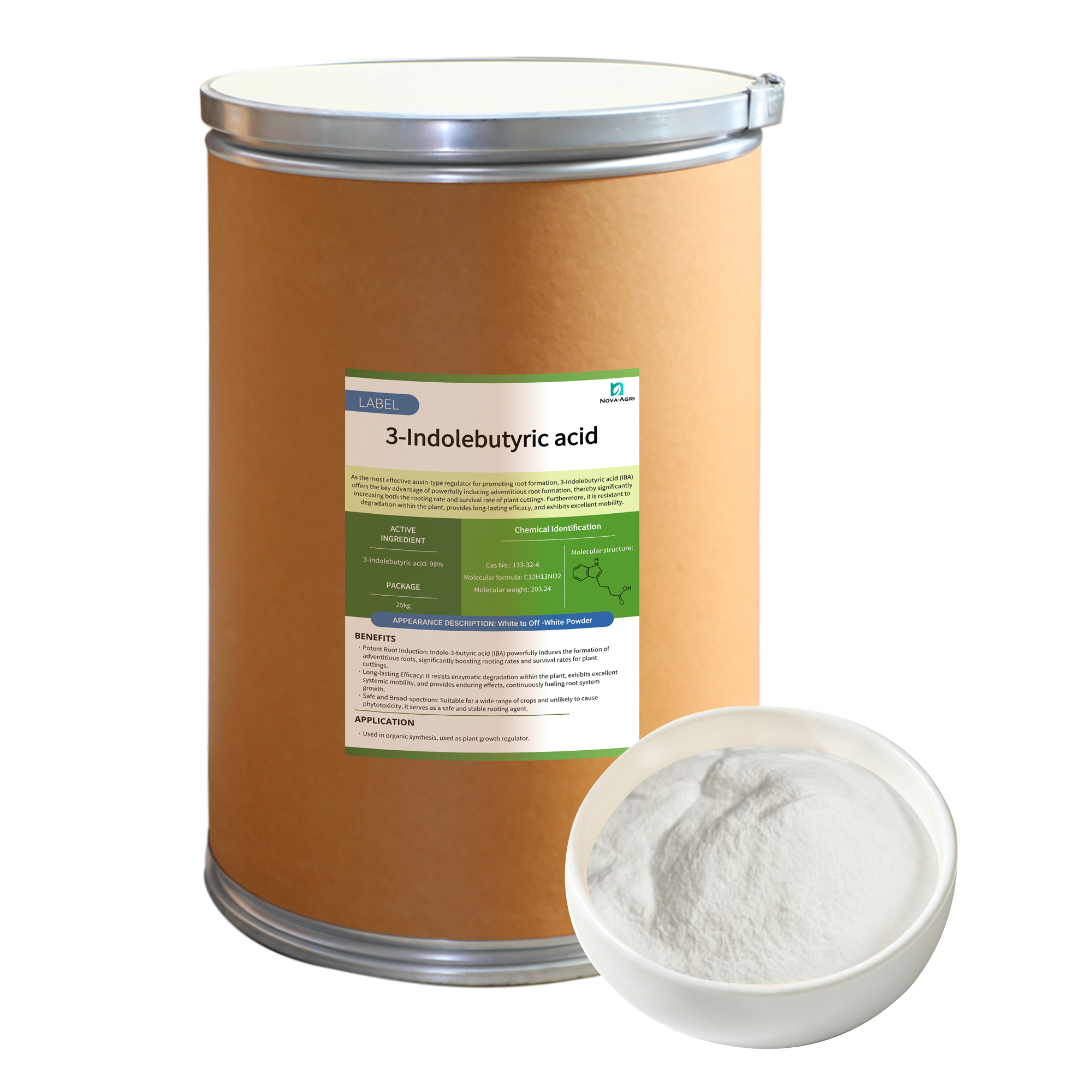
Differences Between Indole-3-butyric Acid (IBA), Indole-3-acetic Acid (IAA), and Naphthaleneacetic Acid (NAA) (with Dosage Chart)
⚠️ Disclaimer: All dosages quoted in this article are industry-typical reference ranges, not product labels. Actual use rates for any specific crop must be confirmed against the registration data of the target market, or by contacting a Nova-Agri specialist. Nova-Agri accepts no liability for outcomes arising from application of these reference rates.
Short answer:
Choose IBA for hard-to-root woody cuttings — it gives the most uniform, vigorous root systems.
Choose NAA when you need fast, broad-spectrum action beyond rooting: fruit set, pre-harvest drop control and thinning.
Choose IAA for research and tissue culture where a natural auxin is required — it is the least stable in the field. Most commercial rooting products use IBA alone or IBA + NAA blends.
All 3 are auxin-type plant growth regulators (PGRs), but they differ in root quality, speed, stability and mobility — and choosing the wrong one wastes both chemical and cuttings.
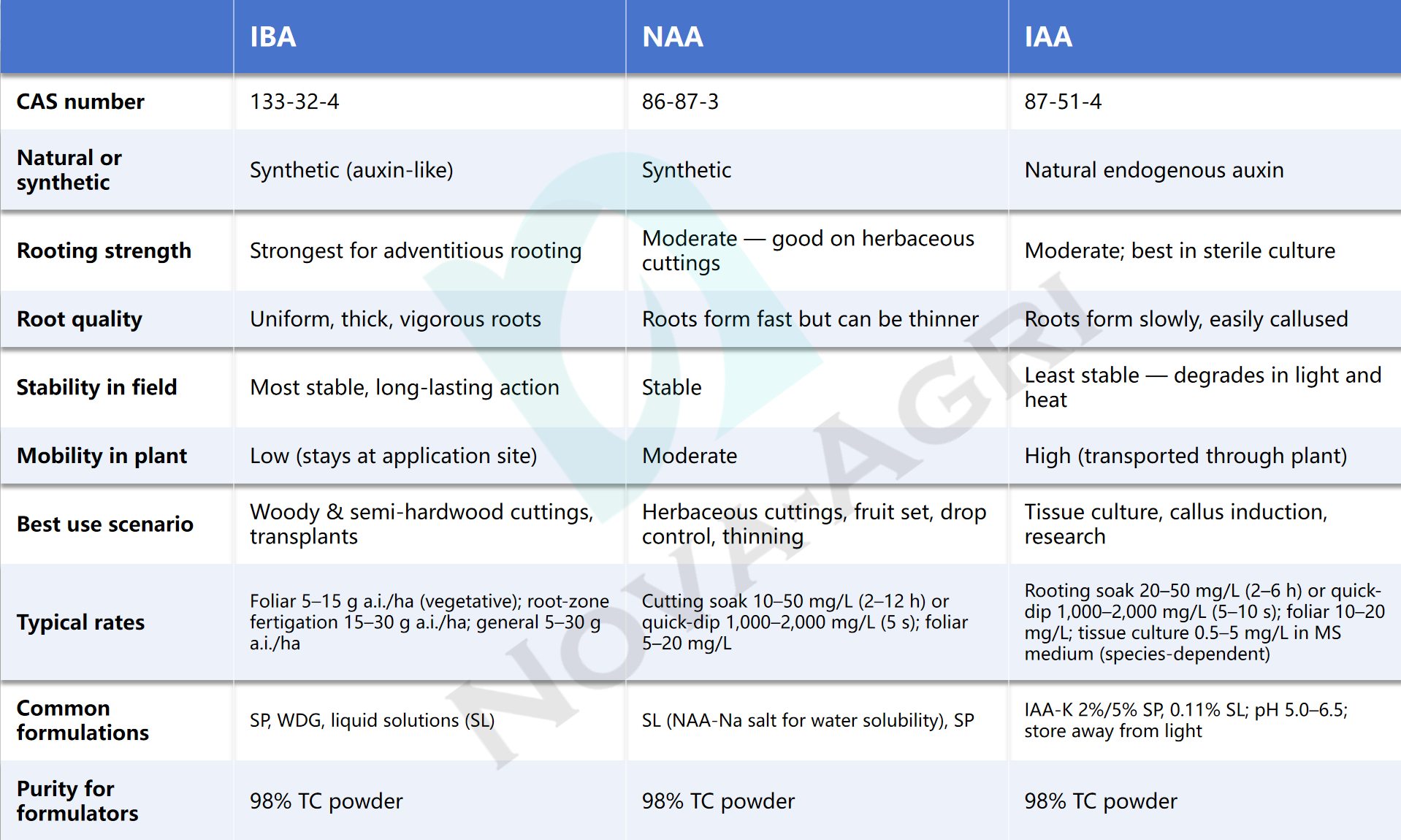
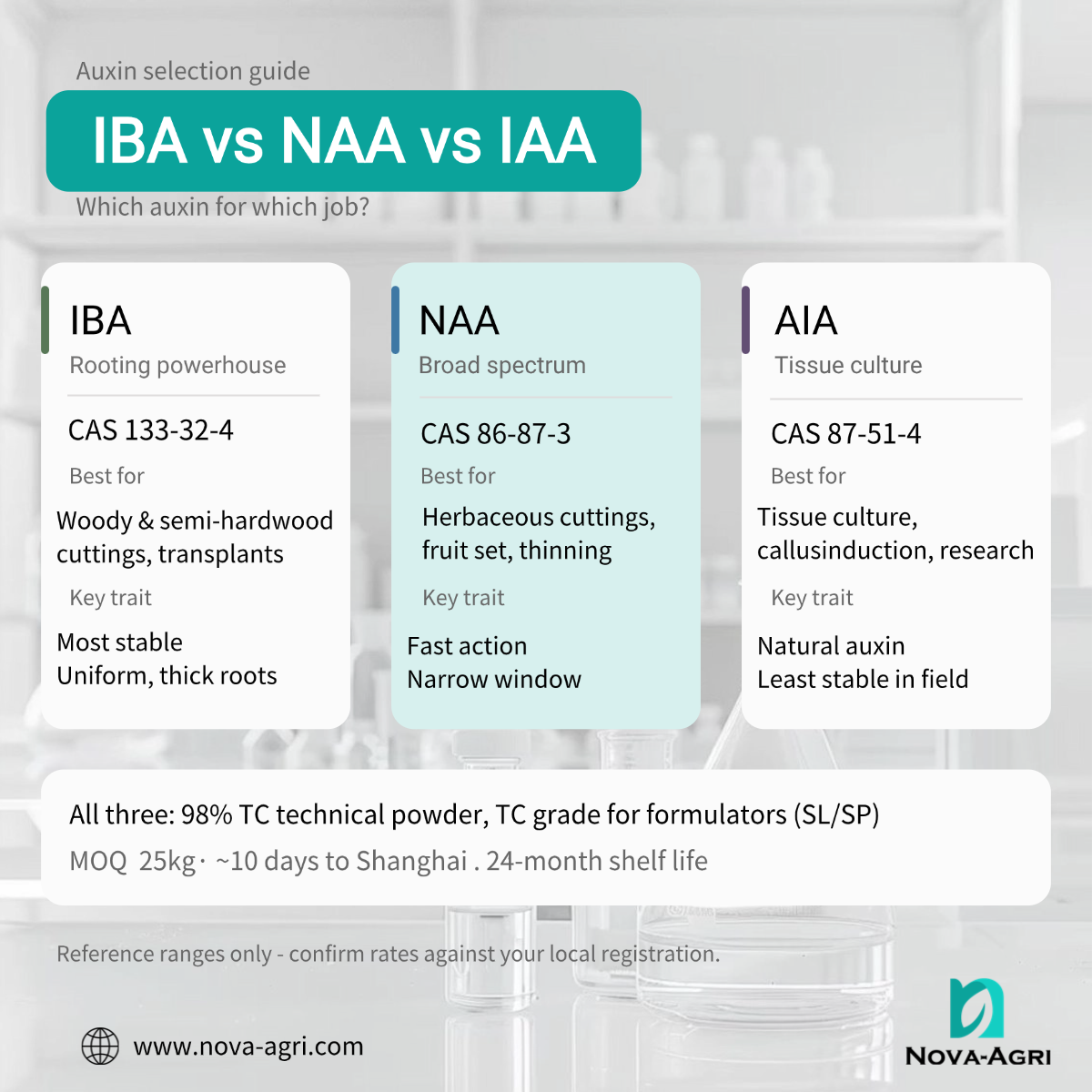
IBA vs NAA vs IAA at a Glance
Which Auxin for Which Job?
Woody and semi-hardwood cuttings → IBA
IBA is the most effective auxin for root formation: it strongly induces adventitious roots and raises both rooting rate and survival of cuttings and transplants. Because it is stable and stays where you apply it, a single treatment keeps working at the cutting base instead of being transported away. Typical use: 5–15 g a.i./ha foliar during vegetative stages, or 15–30 g a.i./ha root-zone fertigation for root branching and drought resilience (general range 5–30 g a.i./ha). This is why IBA 98% TC technical powder is the backbone of most premium commercial rooting formulations.
Herbaceous cuttings and nursery propagation → NAA (or IBA + NAA)
Herbaceous species root easily and respond quickly to NAA: soak cuttings at 10–50 mg/L for 2–12 hours, or quick-dip 1,000–2,000 mg/L for 5 seconds. NAA's extra value shows after rooting — at 10–20 mg/L applied 14–21 days before harvest it prevents pre-harvest fruit drop, and at 5–15 mg/L one to two weeks after bloom it thins excess fruit. General foliar rate: 5–20 mg/L. Note that NAA's concentration window is narrow: the difference between "drop control" and "thinning" is only a few mg/L, so tank-mix accuracy matters.
Tissue culture and research → IAA
IAA is the primary natural endogenous auxin: it regulates cell elongation, differentiation and vascular development. In sterile culture it performs well for callus induction and micropropagation — typical tissue culture rates are 0.5–5 mg/L in MS medium (adjust by species and by callus-induction vs. shoot-induction target). In the field it is the least practical choice — IAA degrades quickly in light and heat, so results are inconsistent. Typical rates: rooting soak 20–50 mg/L for 2–6 hours (or quick-dip 1,000–2,000 mg/L for 5–10 seconds); bare-root transplant soak 10–25 mg/L for 1–2 hours; general foliar rate 10–20 mg/L.
Mixing Auxins: What Formulators Actually Do
Commercial rooting products rarely rely on a single auxin. NAA is universally co-formulated with IAA or IBA — typically at 1:1 to 9:1 (IBA:NAA) ratios, with the optimal ratio depending on species, cutting type and target effect — to combine IBA's root quality with NAA's speed and spectrum. If you formulate, start from 98% TC powders: IBA goes into SP, WDG or liquid solutions; NAA is usually formulated as its NAA-Na salt for water solubility; IAA-K is available as 2%/5% SP or 0.11% SL (keep pH 5.0–6.5 and store away from light).
Safety notes for all three: over-concentration causes auxin herbicide effects (growth stunting, leaf curl, callus without roots); auxin sprays should not be tank-mixed with strongly alkaline solutions; and rates above the labeled range do not improve rooting — they kill it.
FAQ
Which is better for woody cuttings, IBA or NAA?
IBA. It is the most effective auxin for adventitious root formation and produces more uniform, vigorous roots on hard-to-root species. NAA works better on herbaceous cuttings and for fruit-set purposes.
Can I mix IBA and NAA in one product?
Yes. IBA + NAA (or NAA + IAA) co-formulation at 1:1 to 9:1 (IBA:NAA) ratios is the standard approach for premium commercial rooting products — IBA delivers root quality, NAA adds speed and broad-spectrum action; the optimal ratio is species-dependent and should be pre-tested.
What purity and form do formulators buy?
98% TC (technical) powder is the standard formulator grade for all three auxins — supplied as TC grade for formulators, to be formulated into SL/SP. CAS numbers: IBA 133-32-4, NAA 86-87-3, IAA 87-51-4.
What are MOQ, lead time and shelf life?
MOQ 25kg; lead time about 10 working days to Shanghai port; OEM packaging and batch COA available; 24-month shelf life.
Technical-Grade Auxins from Nova-Agri
- IBA 98% TC technical powder — the rooting auxin backbone for woody cuttings and transplant establishment
- NAA 98% TC technical powder — broad-spectrum auxin for rooting, fruit set, drop control and thinning
- IAA 98% TC technical powder — natural endogenous auxin for tissue culture and research
All 3 are TC grade for formulators; formulate into SL/SP. OEM and batch COA available.
⚠️ Disclaimer (repeat): All dosages quoted in this article are industry-typical reference ranges, not product labels. Actual use rates for any specific crop must be confirmed against the registration data of the target market, or by contacting a Nova-Agri specialist. Nova-Agri accepts no liability for outcomes arising from application of these reference rates.
Partner With Us
Interested in the products mentioned?
Contact our export team for availability and partnership opportunities.