
Oct 20, 2026
Rhamnolipid vs Silicone Surfactants: Which Adjuvant Fits Your Formulation?
Related products
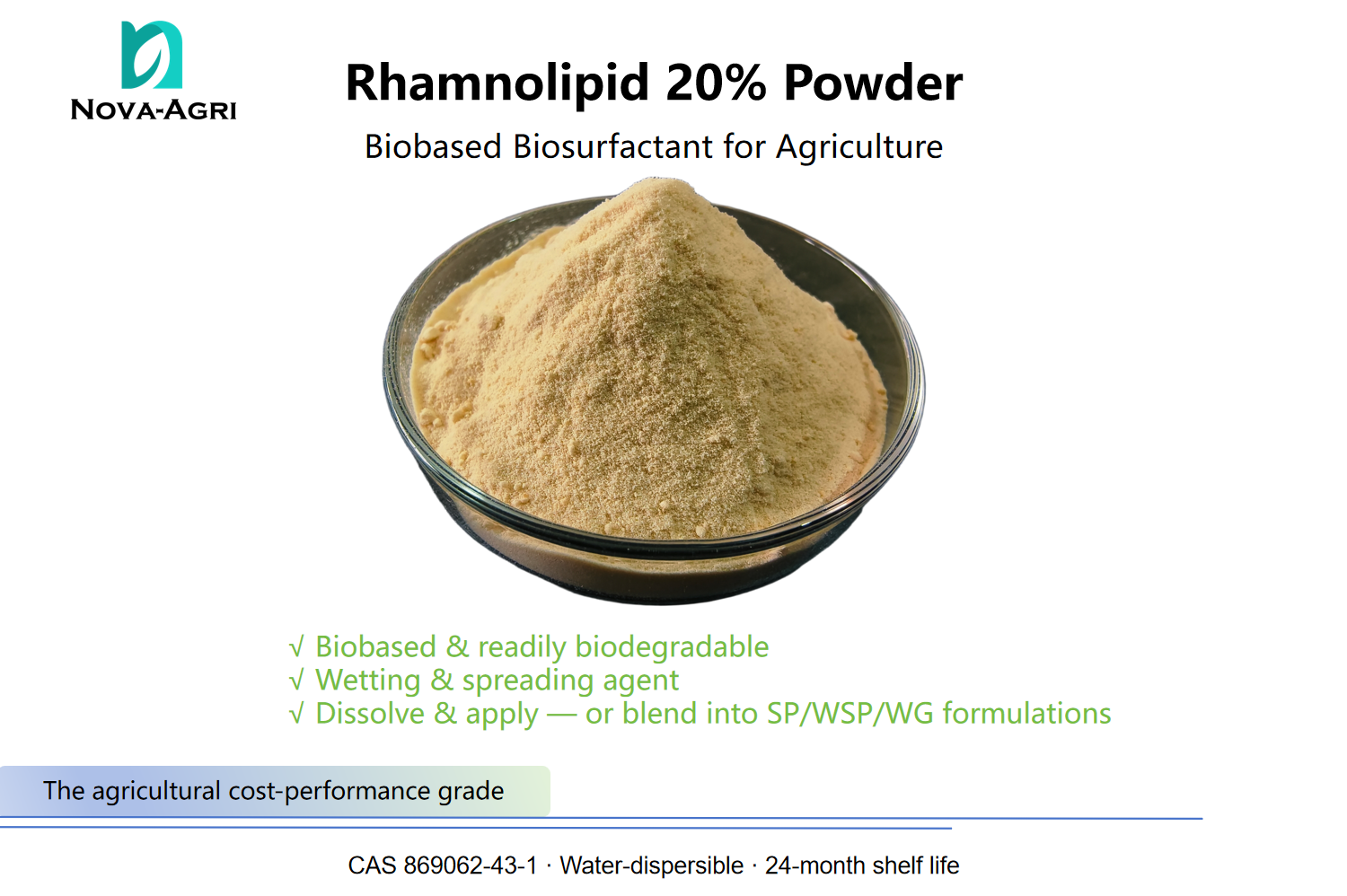
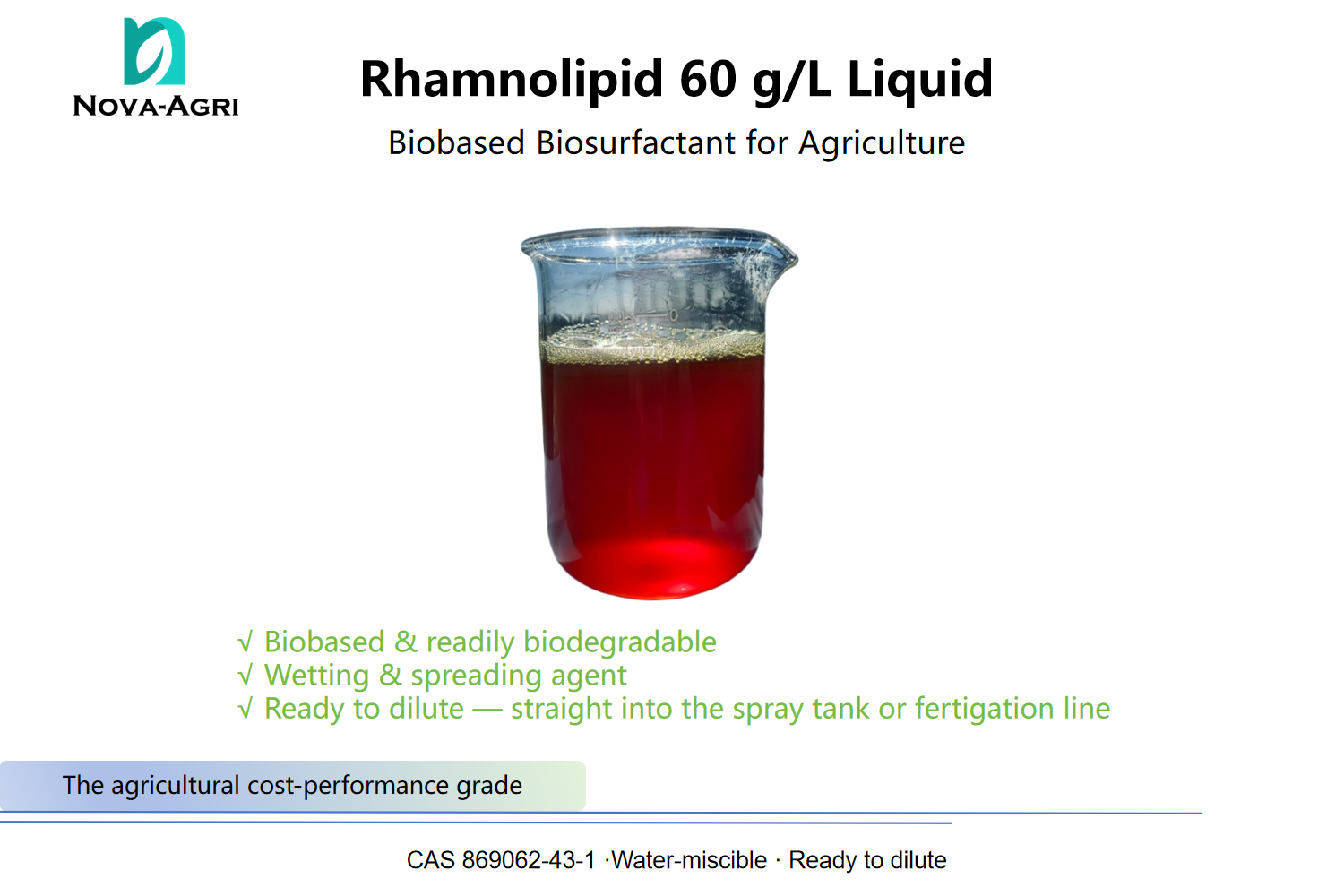
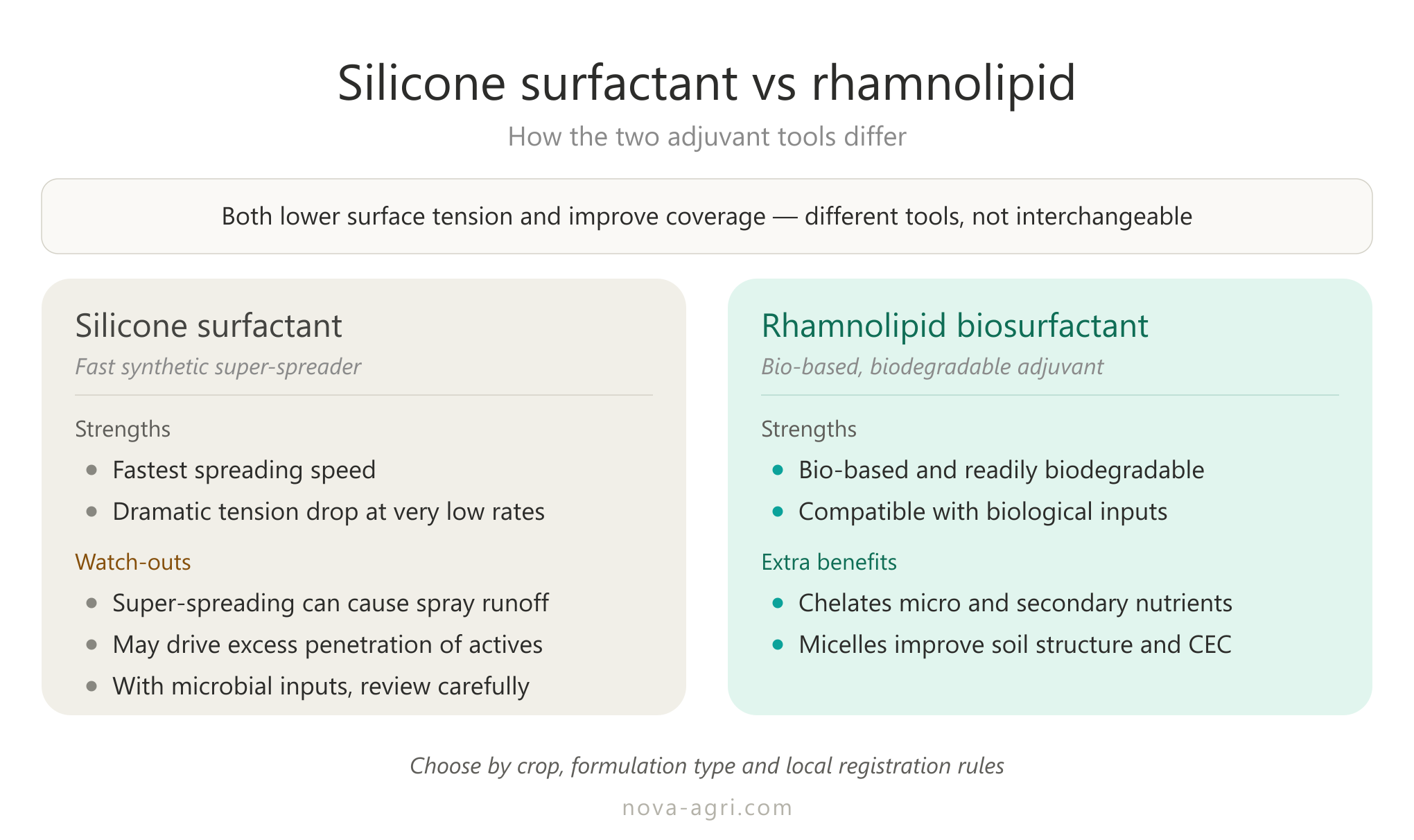
Silicone (organosilicone) surfactants and rhamnolipid biosurfactant both lower the surface tension of a spray tank and improve coverage on the leaf — but they are different tools, and they are not interchangeable. Silicone super-spreaders are synthetic trisiloxanes that push surface tension down to roughly 20–22 mN/m at very low use rates. Rhamnolipid is a fermentation-derived biosurfactant that plateaus at 26 mN/m and adds nutrient chelation and soil benefits on top of wetting. In practice, your decision comes down to four questions: what is your active ingredient — a conventional chemistry or a living microbe; how waxy is your leaf surface; do you tank-mix with biological inputs; and what does registration in your target market allow. And you do not have to pick just one — a rhamnolipid + silicone blend is worth testing when you need both speed and staying power (see the blend section below).
(New to rhamnolipid itself? Start with our overview: What Is Rhamnolipid? The Biosurfactant Explained for Agriculture.)
Quick answer: which adjuvant fits which job
Your situation | Better fit | Why |
Waxy leaves, ultra-low-volume spraying, herbicide programs that need maximum spreading | Silicone super-spreader | Trisiloxanes can drive surface tension below 22 mN/m — the fastest spreading available |
Tank mixes with live microbes (Bacillus, Trichoderma), biopesticides or biostimulants | Rhamnolipid | Bio-based and generally compatible with biological inputs; synthetic surfactants may affect live cells |
Foliar fertilizers and micronutrient sprays where uptake matters | Rhamnolipid | Forms complexes with Cu, Mn, Zn and other nutrients, helping them stay available |
Soil wetting, compaction, salinity or aggregate structure | Rhamnolipid | Negatively charged micelles support aggregate stability and cation-exchange capacity |
Fast rain-fastness with systemic actives | Silicone super-spreader (mind crop safety) | Fastest spreading and penetration, and rain-fastness builds quickly — but overly aggressive penetration raises phytotoxicity risk, and once spreading and penetration are complete, a silicone adjuvant offers the crop nothing further |
Fast spreading plus a post-spray benefit for the crop (nutrient uptake, stress tolerance) | Rhamnolipid + silicone blend (available from Nova-Agri) | Silicone handles rapid spreading and penetration; rhamnolipid supports uptake and keeps working at the biostimulant level after the spray has done its job |
Spraying in hot weather (above ~32 °C / 90 °F) | Both need care; silicone risk is higher | US extension guidance recommends keeping organosilicones below 90 °F |
Why they behave differently
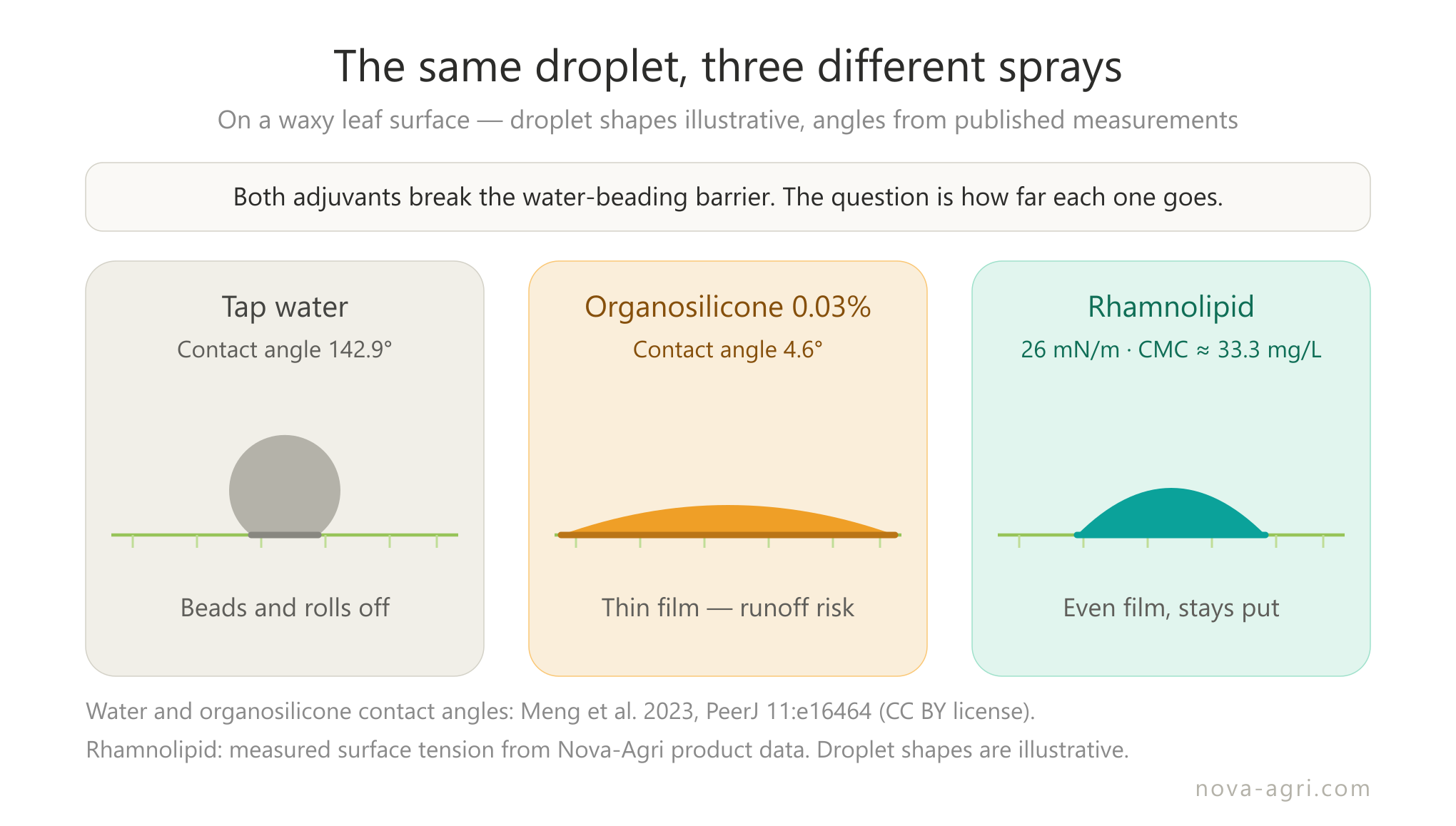
An organosilicone super-spreader is a polyether-modified trisiloxane — a non-ionic surfactant with a compact, flexible silicone hydrophobe that packs very efficiently at the air–water interface. That is why a very small dose (typically 0.025–0.1% of spray volume) can pull surface tension from water's ~72 mN/m down to about 20–22 mN/m. At that level the contact angle collapses toward zero, the spreading coefficient turns positive, and a droplet flattens into a thin film — the "super-spreading" behaviour that made these products standard in low-volume and drone applications.
Rhamnolipid is a glycolipid biosurfactant: a hydrophilic rhamnose head paired with hydrophobic fatty-acid tails, produced by fermentation. Its surface-tension curve reaches its lowest point — 26 mN/m — at the critical micelle concentration (CMC ≈ 33.3 mg/L), and adding more material does not lower it further. Above the CMC, the molecules assemble into negatively charged micelles, which is the origin of its chelation and soil effects.
One point is easy to overlook: lower surface tension is not automatically better. Super-spreading can thin a deposit to the point where solution drains off the leaf, and it can drive penetration harder than some actives want. When the active must stay on the leaf surface to work — contact-acting chemistry, live microbials, some biopesticides — extreme spreading works against you.
Five things to check before you add a silicone super-spreader
Run-off from super-spreading. When a droplet spreads into an extremely thin film, solution can leave the leaf entirely. Organic-farming extension resources flag this directly: the adjuvant can spread so aggressively that the spray no longer stays where the target is.
Penetration cuts both ways. Faster penetration does build rain-fastness quickly — but it also raises phytotoxicity risk. Over-penetrated spray solution is harder on young tissue and in hot conditions, which is why silicone super-spreaders are avoided on some crops and growth stages.
A narrow job description. A silicone adjuvant's task is spreading and penetration. Once that job is done, it contributes nothing further to the crop. If your foliar program also targets nutrient uptake, stress tolerance or soil-conditioning benefits, those have to come from something else in the tank.
Temperature. US extension guidance recommends using organosilicones below 90 °F (≈32 °C); above that, leaf burn risk rises sharply.
pH and hydrolytic stability. The siloxane bonds that make these surfactants so effective also hydrolyse outside a roughly neutral window — the practical working range is about pH 6–8, and a prepared mix should be sprayed promptly rather than held for days.
If live microbes are in the tank, treat compatibility as an open question and test it — do not assume it.
What rhamnolipid adds beyond wetting
Bio-based and readily biodegradable. Produced by fermentation, it suits residue-sensitive crops and export-oriented supply chains.
Compatible with biological inputs. At normal use concentrations it generally does not compromise common microbial inoculants (Bacillus, Trichoderma and others) — but verify strain by strain with a jar test.
Chelates micro and secondary nutrients. Published research reports that rhamnolipid forms lipophilic complexes with metal ions such as Cu, Mn and Zn, helping these elements stay available for uptake (reported in published literature — laboratory data).
Soil-side benefits. Research indicates rhamnolipid supports soil aggregate stability and cation-exchange capacity. In saline-soil studies, reported outcomes include soil pH falling from 8.87 to 7.80–7.84, salt leaching of up to about 20.7%, and suppression of some pathogens such as Fusarium spp. (laboratory and pot-study data; results vary widely with soil type and rate — not a product performance claim).
It keeps working after the spray has landed. Rhamnolipid is not only a carrier for other inputs. Published research (Shen et al. 2026, J. Agric. Food Chem.) reports that low concentrations (5–10 mg/L in the lab; roughly 45 g/ha in the field) up-regulate genes tied to gibberellin (GA3) and zeatin synthesis, nitrogen uptake and photosynthesis, with two-year wheat trials showing yield gains of 11.9% and 14.8%. A wider body of research describes it as an elicitor that switches on the plant's own defence responses (ROS burst, Ca²⁺ influx, defence-gene expression). And in soil it is degraded and used as a carbon source by microorganisms — strains able to grow on rhamnolipid as their sole carbon source have been isolated — so it does not persist or accumulate. In short: after helping other inputs get absorbed, it keeps contributing at the biostimulant level. (literature and controlled-trial data — not a product performance claim)
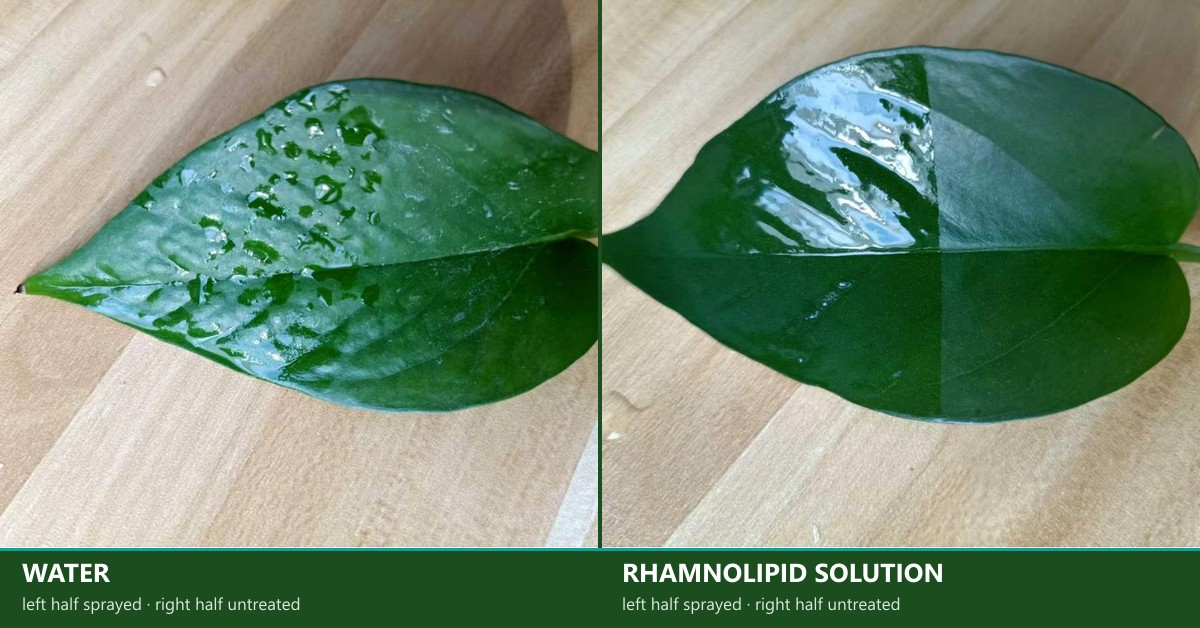
Not an either-or choice: rhamnolipid + silicone blends (available from Nova-Agri)
The two adjuvants are not substitutes — they can be combined by division of labour:
Silicone covers "fast": rapid spreading, rapid penetration, rain-fastness built in a short window.
Rhamnolipid covers "what follows": uptake support that starts within a short time after spraying (an observation from our application experience, not a figure from published literature), plus biostimulant-level activity of its own — induced resistance, nutrient uptake and root development — while the material is finally consumed by soil microorganisms rather than persisting (see point 5 above).
A blend is worth testing when:
you need fast spreading and penetration and a post-spray benefit for the crop (uptake, stress tolerance);
the tank holds both a conventional active and a biostimulant or foliar nutrition, and one pass should serve both goals;
a customer currently uses silicone only, but phytotoxicity incidents or its single-function profile are pushing them to look for an improved option.
*Before a blend goes to the field, run jar tests first:
The ratio must be measured for your system. Blend rates are not a copy of either adjuvant's solo rate — determine them experimentally for each formulation. (No universal recommended ratio exists; Nova-Agri can support the testing with samples and documentation.)
Phytotoxicity risk adds up. The silicone's aggressive penetration also amplifies the blend's crop-safety risk — extra care on young tissue and in hot weather.
Both pH windows must hold at once. Silicone ~6–8 and rhamnolipid ≥ 4 — work inside the intersection.
Do not add a highly penetrating silicone to tanks with live microbes — it acts directly on cell viability; verify strain by strain.
Regulation and certification: how to verify
United States. Rhamnolipid biosurfactant is registered as a biochemical pesticide active ingredient with EPA (PC Code 110029). The first product containing it, Zonix™ Biofungicide (EPA Reg. No. 72431-1), was approved on 23 March 2004 for zoosporic plant pathogens such as downy mildews, Pythium and Phytophthora, and received an exemption from the requirement of a tolerance for all food commodities on 31 March 2004. Its mode of action is physico-chemical: the surfactant disrupts the cell membrane of zoospores, which lack a protective cell wall.
Where the claim sits. Nova-Agri supplies rhamnolipid as raw material and also as OEM / private-label finished products (packaging arranged to customer requirements), with COA, TDS and SDS documentation. Pesticide and fungicide claims on a finished label are the responsibility of the registration holder in each country — we support registrants with the technical dossier.
Organic certification is product-specific. Some commercial rhamnolipid adjuvants have been listed by OMRI, but listing is granted to a specific product and formulation. Confirm the exact product with your certifier and with the supplier of the product you intend to use — never assume it transfers from one brand to another.
European Union. Organic inputs must meet the separate requirements of EU Regulation 2018/848.
Frequently asked questions
Can rhamnolipid simply replace silicone surfactants? No. They are different tools. When you need extreme spreading on waxy leaves with very low spray volumes, silicone still has no direct substitute. When you need biological compatibility, biodegradability or chelation, rhamnolipid is the better fit. Where you need both speed and a post-spray benefit, a blend is the option to test.
Can I tank-mix a silicone adjuvant with a microbial inoculant? Test it first. Synthetic surfactants can reduce the survival of live cells, and tolerance varies enormously between strains. There is no safe general answer — only a jar test with your specific pair. If your tank includes live microbes, the more conservative route is a bio-based adjuvant such as rhamnolipid, or keeping the silicone rate minimal and validating each strain.
Why do silicone adjuvants work at such low rates? Because trisiloxane surface activity is extremely high — a very small concentration produces a very large drop in surface tension. That efficiency is also why their effect on a tank is more aggressive, in both directions.
Can I use a silicone adjuvant in hot weather? It is not recommended. US extension guidance suggests staying below 90 °F (≈32 °C), because phytotoxicity risk climbs sharply above it.
Is rhamnolipid suitable as a foliar fertilizer adjuvant? Yes. Beyond wetting and spreading, it complexes secondary and micronutrients — an ability a plain surfactant does not have.
How do I decide between them? Start from your performance gap. If your gap is extreme spreading, evaluate a silicone super-spreader. If your gap is biological compatibility, residue profile, nutrient chelation or soil conditioning, evaluate rhamnolipid. If you need fast spreading and a post-spray crop benefit, test the rhamnolipid + silicone blend. Either way, decide on the basis of your specific crop, formulation type and local registration rules — and confirm with a jar test.
Silicone super-spreaders and rhamnolipid biosurfactant are not competitors for the same slot in a formulation — they solve different problems. Silicone wins on raw spreading speed at minimal dose, with real cautions around run-off, crop safety and pH — and its job ends when the droplet has spread and penetrated. Rhamnolipid wins wherever a bio-based, biodegradable material compatible with biological programs is worth more than an extra few mN/m of spreading — and it keeps working after deposition: chelating nutrients, conditioning soil and acting at the biostimulant level. Where both profiles matter, the blend — not a choice between them — is often the practical answer. The right starting point for your formulation is a jar test, not a specification sheet.
Request the COA, spec sheet or a sample → Rhamnolipid 20% Powder · Rhamnolipid 60 g/L Liquid · Contact Nova-Agri
Read next: What Is Rhamnolipid? The Biosurfactant Explained for Agriculture
Disclaimer: This article is for general information only. Statements about antimicrobial or insecticidal activity are based on published scientific literature and laboratory data; rhamnolipid as supplied by Nova-Agri — as raw material or OEM finished product — is intended for formulation use, not a registered pesticide. References to third-party products and EPA registrations are provided for context and are not endorsements. Always follow the product technical sheet and local regulations for your intended use.
Partner With Us
Interested in the products mentioned?
Contact our export team for availability and partnership opportunities.