
Sep 20, 2026
S-ABA (S-Abscisic Acid): What It Is, How It Works in Grapes and Crops, and How to Formulate It
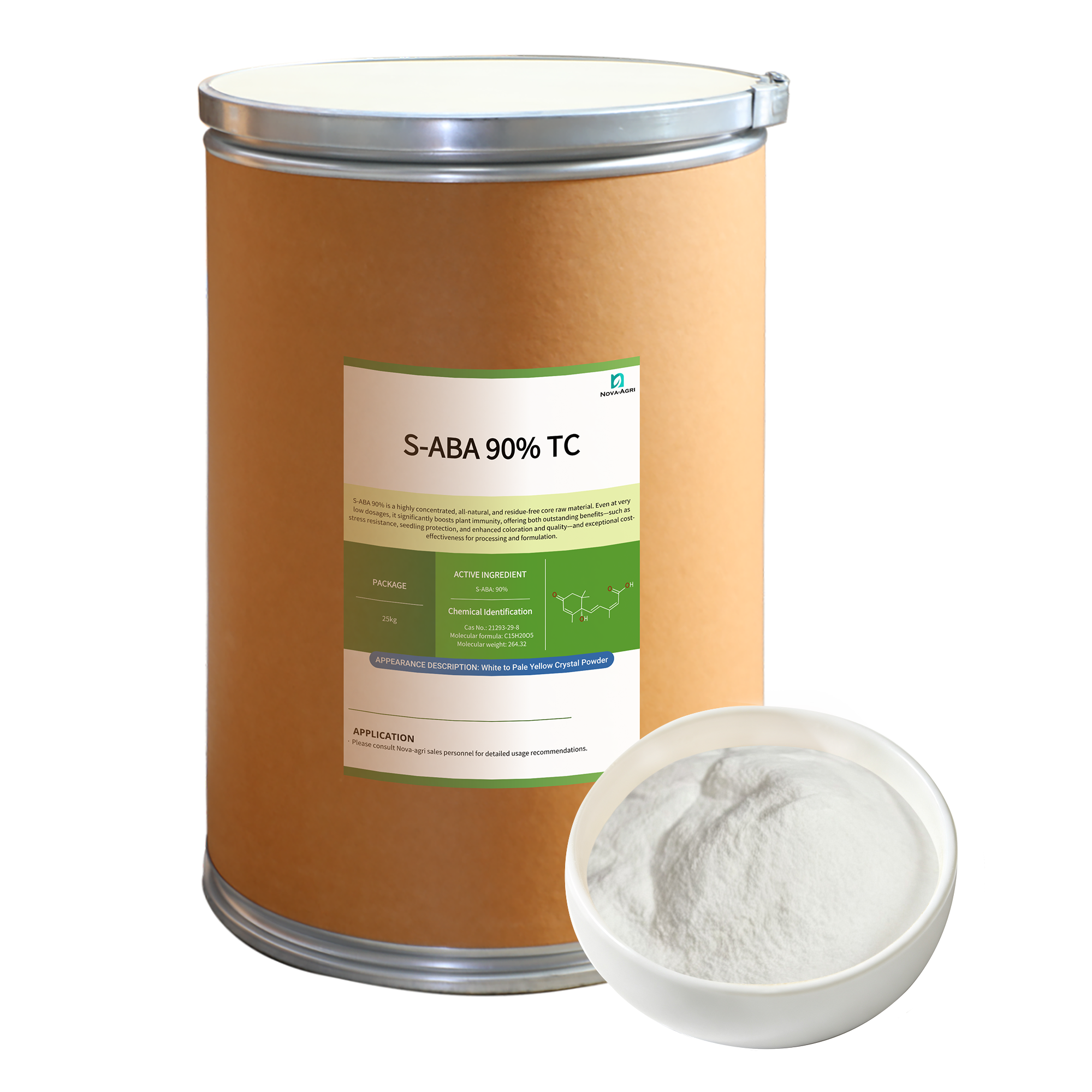
S-ABA (S-abscisic acid, CAS 21293-29-8) is the natural (+)-enantiomer of abscisic acid, one of the five classical plant hormones. Produced by microbial fermentation, it closes stomata to cut water loss, improves crop tolerance to drought, cold and salinity, reduces transplant shock, and drives anthocyanin accumulation for red berry coloration in table grapes at veraison. Nova-Agri supplies S-ABA in three commercial grades — 90% TC powder, 20% SG water-soluble granules and 10% SP soluble powder — with MOQ from 25 kg, delivery in about 10 working days to Shanghai port, and a batch COA for every shipment.
⚠All application rates referenced in this article are industry-typical reference ranges, not product labels. Actual use rates for any specific crop must be confirmed against the registration data of the target market, or by contacting a Nova-Agri specialist. Nova-Agri accepts no liability for outcomes arising from the application of these reference rates.
What is S-ABA (S-abscisic acid)?
Abscisic acid (ABA) is one of the five major plant hormones, alongside auxins, gibberellins, cytokinins and ethylene. In plants it acts as the primary "stress hormone": levels rise naturally when a plant experiences drought, cold or high salinity, triggering protective responses.
Commercially, the form that matters is S-ABA — the natural (+)-enantiomer of abscisic acid (CAS 21293-29-8). Abscisic acid exists as two mirror-image isomers: the naturally occurring S-(+)-ABA, which is highly biologically active, and the much less active R-ABA. Synthetic chemical routes produce a racemic (±)-mixture of both isomers, which effectively halves the usable active content for field performance. That is why S-ABA produced by microbial fermentation, delivering the pure (+)-enantiomer, is the reference material for high-performance formulations.
Quick facts for formulators:
Parameter | Value |
|---|---|
Common names | S-ABA, S-abscisic acid, (+)-abscisic acid, ABA |
CAS No. | 21293-29-8 |
Molecular formula | C15H20O4 |
Molecular weight | 264.32 |
Source | Microbial fermentation |
Appearance (TC) | White to off-white crystalline powder |
What does S-ABA do? Four key roles in crops
1. Stress tolerance through stomatal closure
S-ABA closes stomata within hours of application, cutting transpiration and water loss under drought and heat. The mechanism is well-characterized: ABA binds to PYR/PYL/RCAR receptor proteins in guard cells, which inhibits type 2C protein phosphatases (PP2C), in turn releasing the kinase OST1 to drive stomatal closure through SLAC1 anion channel activation. In the field this translates into faster recovery from cold, salinity and drought stress, and better yield protection in warm, water-limited growing regions. This is the dominant agronomic use case for S-ABA in Mediterranean and arid-climate agriculture.
2. Berry coloration in table grapes
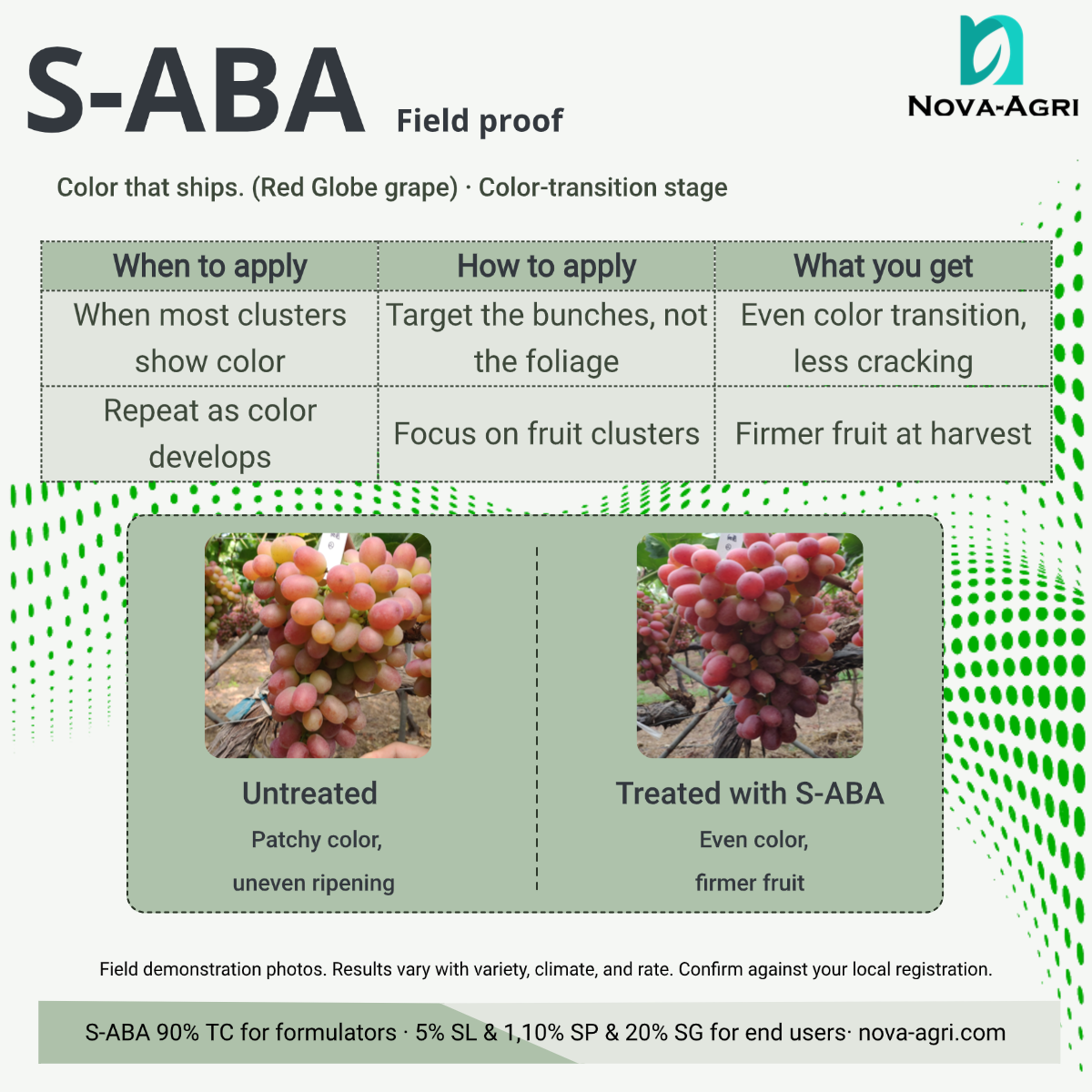
S-ABA promotes anthocyanin accumulation in grape berry skin, giving more uniform red color at veraison — the single largest commercial application of this molecule (covered in detail below). Unlike ethephon, S-ABA treatment does not advance ripening and does not soften the berry, which preserves fruit firmness, transport tolerance and post-harvest shelf life — the practical reasons international packers prefer S-ABA over ethylene-releasing alternatives for premium export grapes.
3. Reduced transplant shock
Applied as a seedling root dip or early-stage foliar spray, S-ABA improves survival and establishment after transplanting by reducing transpiration during the recovery period when the root system is not yet functional. This is a useful tool for vegetable, fruit and flower seedling producers, and for nursery lines where transplant shock translates directly into yield loss or stand failure.
4. Formulation synergy with other PGRs
S-ABA combines well with GA3 and 6-BA in fruit-quality and coloring programs, allowing formulators to build multi-component PGR solutions for premium horticultural crops. A typical commercial "color pack" combines S-ABA with a low-rate GA3 and 6-BA to push berry size, color and uniformity in one program — the kind of blend international distributors request for branded retail products.
S-ABA for grape coloring: how it works, and how it compares with ethephon
In red table grape varieties grown in warm climates, inadequate or uneven color development directly reduces marketable yield and export value. S-ABA is the plant's own signal for this process: it stimulates the enzyme UDP-glucose-flavonoid 3-O-glucosyltransferase (UFGT), which converts anthocyanidins into the red anthocyanin pigments that give berries their color.
Because S-ABA is a compound found naturally in grapes, treated berries keep a natural appearance and maintain good quality at harvest and through storage. Application is keyed to the start of veraison, with rates of 25–100 mg/L a.i. applied to the grape clusters (see application guide below).
S-ABA compared with ethephon, the traditional coloring option (full side-by-side analysis: S-ABA vs Ethephon for Grape Color: Which to Use and When):
S-ABA | Ethephon | |
Color uniformity | Stable, uniform response | Can be inconsistent under some conditions |
Berry firmness | Maintained | May be reduced |
Post-harvest quality | Good shelf-life performance | May soften during storage |
The commercial potential of S-ABA in this segment is well established by the international reference product ProTone® (a registered trademark of Valent BioSciences Corporation, a subsidiary of Sumitomo Chemical), which is sold as a 20% soluble granule for conventional spray equipment, with a 10% liquid formulation developed for electrostatic sprayers in some markets. This is also why formulators searching for S-ABA increasingly look for 20% SG and 10% SP type grades — the formulation formats the market is already familiar with.
Molecular mechanism: UFGT pathway and anthocyanin biosynthesis
The ABA-driven color response in grape skin runs through a well-characterized transcriptional cascade. S-ABA signaling upregulates the MYB-bHLH-WD40 (MBW) transcription factor complex, which directly activates the UFGT promoter. UFGT (UDP-glucose:flavonoid 3-O-glucosyltransferase) catalyzes the final glycosylation of anthocyanidins — pelargonidin, cyanidin and delphinidin — into the stable anthocyanin pigments that accumulate in berry skin vacuoles. Concurrently, ABA suppresses the negative regulator MYB4, removing a brake on the phenylpropanoid pathway. The net effect is faster, more uniform color development without the ripening acceleration (and softening) caused by ethylene-releasing agents.
This is also why timing matters: S-ABA applied before veraison has limited effect because UFGT expression is naturally low; applied at the start of veraison, when the berry has switched from acid accumulation to sugar import, the MBW complex is most receptive. This is the reason application guides consistently anchor S-ABA sprays to veraison onset, not earlier.
Compatibility & tank-mixing notes
For formulators and field applicators:
Avoid alkaline tank-mix partners (pH > 8). S-ABA isomerizes rapidly under alkaline conditions, with significant activity loss within hours. Check the pH of carrier water and any mixing partner.
UV sensitivity. Apply in the evening or on overcast days. Spray deposits exposed to direct sunlight degrade measurably within 24 hours.
Commonly compatible partners: most fungicides (mancozeb, pyraclostrobin, etc.), most insecticides, GA3, 6-BA, NAA in coloring programs. Always jar-test before scale.
Avoid copper-based fungicides in the same tank without a compatibility check — copper ions can accelerate ABA oxidation.
Sequential applications are fine. A 5–7 day interval between S-ABA and any other PGR is a safe default.
Registration support for your target market
For customers who need to register S-ABA end products in their own market, Nova-Agri supports the submission process by providing the data sets and reports typically requested by national regulators — including COA, TDS, MSDS, 5-batch HPLC report, impurity profile, and the physical-chemical parameter sets needed for dossier preparation. Customers carry out and own the national submission; we supply the documents that go with it.
If you are starting a new registration and want to know what we can provide, please contact our technical team with your target country and crop.
Formulation guide: 90% TC, 20% SG and 10% SP
Nova-Agri supplies S-ABA in three grades, matched to different points in the value chain:
Grade | Typical use |
S-ABA (S-Abscisic Acid) 90% TC Powder | Technical material for formulators producing their own SL, SP or SG end products |
S-ABA (S-Abscisic Acid) 20% SG | Water-soluble granule for direct-use or regional distribution, the market-standard format for grape coloring programs |
S-ABA (S-Abscisic Acid) 10% SP | Soluble powder, 100% water-soluble for direct dilution in the field |
Key formulation notes for TC users:
S-ABA 90% TC is sparingly soluble in water. Dissolve it in methanol, ethanol or acetone, or neutralize it with dilute alkali to form a soluble salt for aqueous formulations.
Typical end products are 10%–25% SL/AS solutions or water-soluble granules (SG/WSP).
Avoid alkaline formulation pH and UV light. S-ABA isomerizes and loses activity under strong light — this applies to formulation, storage and field application alike.
Store in a cool, dry, dark place away from direct sunlight, in the original sealed packaging. Shelf life is 24 months.
Application guide
Application rates depend on the purpose. The reference rates below apply to S-ABA active ingredient (a.i.):
Purpose | Rate | Notes |
Stress mitigation (drought, cold, salinity) | Foliar 10–25 mg/L a.i. | Apply at the onset of stress periods |
Grape berry coloration | 25–100 mg/L a.i. | Spray the clusters at the start of veraison |
Transplant shock reduction | 5–10 mg/L a.i. | Seedling root dip before planting |
Apply in the evening or on cloudy days (UV degrades ABA), and do not tank-mix with alkaline products.
Sourcing S-ABA from Nova-Agri
Nova-Agri is a B2B supplier of biostimulants and PGRs for agrochemical manufacturers, formulators and distributors, exporting to 50+ countries. For S-ABA we offer:
Three grades: 90% TC powder, 20% SG, 10% SP
MOQ from 25 kg, with lead time of about 10 working days to Shanghai port
OEM packaging and private-label support, with a batch COA for every shipment
24-month shelf life in original sealed packaging
Technical data and documentation support for product registration in your target market
View S-ABA (S-Abscisic Acid) 90% TC Powder →
FAQ
What is S-ABA? S-ABA (S-abscisic acid, CAS 21293-29-8) is the natural (+)-enantiomer of abscisic acid, a plant hormone produced by fermentation.
What does S-ABA do? It closes stomata to cut water loss, improves tolerance to drought, cold and salinity, reduces transplant shock, and promotes anthocyanin accumulation for red grape berry coloration at veraison.
What rate of S-ABA is used for grape coloring? 25–100 mg/L a.i. sprayed on the grape clusters at the start of veraison. For stress mitigation, typical foliar rates are 10–25 mg/L a.i.
Is S-ABA natural? Yes. S-ABA is a naturally occurring plant hormone — the (+)-enantiomer produced by fermentation, identical to the compound plants and fruits produce themselves.
What formulations of S-ABA are available? Nova-Agri supplies 90% TC powder for formulators, plus 20% SG and 10% SP ready-to-dilute grades. Typical formulated end products are 10%–25% SL/AS solutions or water-soluble granules (SG/WSP).
What is the MOQ and lead time? MOQ from 25 kg; typical lead time is about 10 working days to Shanghai port. OEM packaging and batch COA are available.
Can S-ABA be tank-mixed with other pesticides? Yes, with most fungicides and insecticides. Avoid alkaline products (pH > 8), copper-based fungicides without a prior compatibility check, and direct UV exposure after spraying.
Where is S-ABA registered? End-product registrations are country-specific and are managed by the local formulator or importer in each market — Nova-Agri is not the holder of those registrations. If you are evaluating registration of an S-ABA end product in your country, Nova-Agri can provide the supporting technical documentation (COA, TDS, MSDS, 5-batch HPLC report, impurity profile, physical-chemical data) for inclusion in your local dossier.
References
For technical validation, see:
Koyama, K. et al. (2018). "Abscisic acid and berry coloration in Vitis vinifera." Scientia Horticulturae — covers UFGT pathway activation by ABA in grape skins.
Ferrara, G. et al. (2013). "Application of S-abscisic acid (S-ABA) to 'Crimson Seedless' grapes for color enhancement." Acta Horticulturae — field trial on table grape color response to S-ABA.
Jeong, S.T. et al. (2004). "Effects of ABA on anthocyanin biosynthesis in grape berries." Postharvest Biology and Technology — mechanism-level study.
Valent BioSciences Corporation. ProTone® product label (EPA Reg. No. 73049-45) — international reference product, 20% SG formulation for grape coloring.
The application rates in this article are general technical references. Always follow the registered product label and the regulations applicable in your country or region before any commercial application.
ProTone® is a registered trademark of Valent BioSciences Corporation (a subsidiary of Sumitomo Chemical Company). Its mention in this article is for technical reference only and does not imply any affiliation, endorsement, partnership or distribution relationship between Nova-Agri and Valent BioSciences Corporation or Sumitomo Chemical Company.
Partner With Us
Interested in the products mentioned?
Contact our export team for availability and partnership opportunities.