
Oct 12, 2026
Brassinolide Types Explained: 24-Epibrassinolide vs 28-Homobrassinolide — Which to Use, and Which Grade to Buy
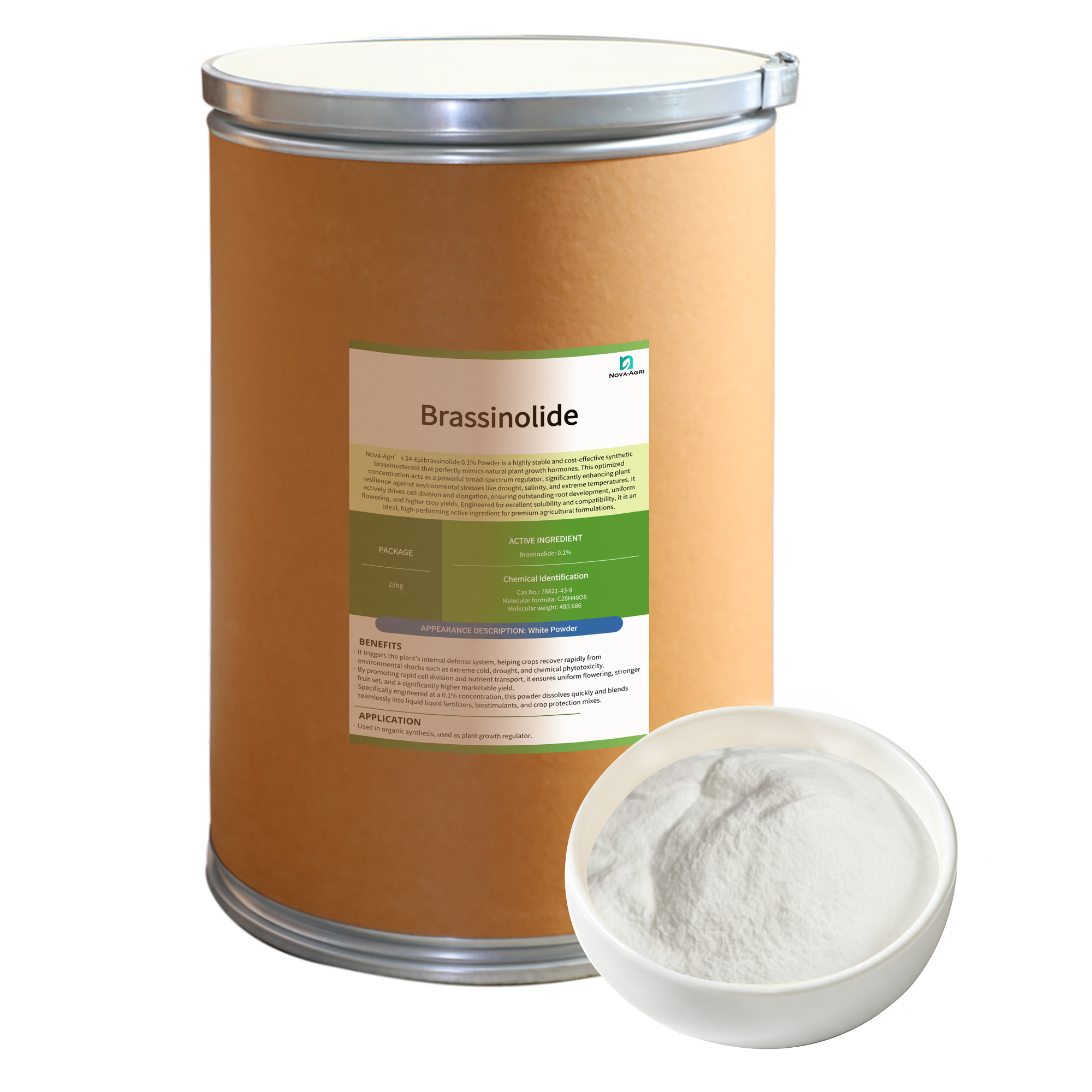
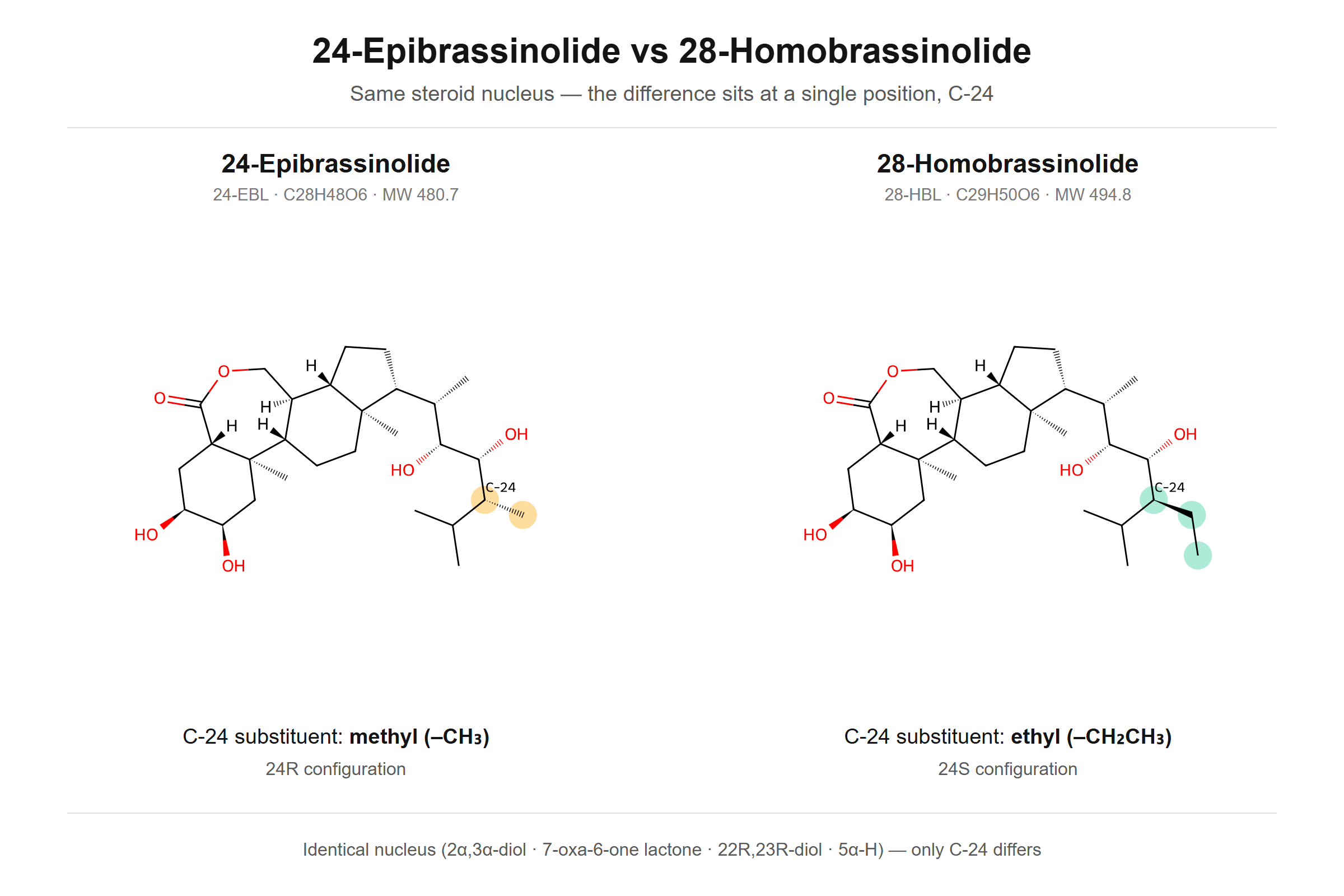
The two brassinolide raw materials that come up in almost every sourcing enquiry are 24-epibrassinolide (CAS 78821-43-9) and 28-homobrassinolide (CAS 82373-95-3). Both belong to the brassinosteroid family — widely described as the sixth class of plant hormones — but their molecules differ at the C-24 position of the side chain: 24-epibrassinolide carries a methyl group (C28H48O6); 28-homobrassinolide carries an ethyl group (C29H50O6). That single extra carbon drives their biological activity, their use rates and the applications they suit — and therefore which one you should buy.
This article is written for formulators, distributors and OEM buyers. It answers three questions: which brassinolides are genuinely used at scale; how 24-epibrassinolide and 28-homobrassinolide differ and how to choose between them; and how to decide between 90% TC technical material, 0.1% SL and 0.1% SP.
Disclaimer: The field use rates and efficacy figures in this article are published research findings or generally accepted industry reference ranges. They are not the label of any specific product. Any actual use rate must follow the registered label of the target market. Nova-Agri accepts no liability for results arising from application based on the reference data in this article.
What is brassinolide, and why is it called the "sixth plant hormone"?
Brassinolide is a class of sterol-type endogenous plant hormone. In the 1970s, researchers isolated a highly active substance from rapeseed (Brassica napus) pollen that promoted stem elongation and cell division, and named it brassinolide. Because it markedly regulates plant growth at extremely low concentrations and shares part of the physiological function of auxins, gibberellins and cytokinins, it was recognised in 1996 as the sixth major class of plant hormones, after auxins, gibberellins, cytokinins, abscisic acid and ethylene.
Its agricultural value can be summarised in four lines: promoting cell division and elongation (rooting, seedling vigour, fruit sizing); increasing chlorophyll content and photosynthetic efficiency; improving fruit set and reducing flower and fruit drop; and strengthening tolerance to abiotic stress such as drought, low temperature and salinity — as well as partially alleviating phytotoxicity caused by herbicides and fungicides.
In one sentence: brassinolide is not a fertiliser. It does not supply nutrients directly; it is a "physiological switch". Its effect depends on the crop, the growth stage and the environmental conditions at application, so choosing the right type and the right grade matters more than simply increasing the dose.
Which brassinolides are the most used in agriculture?
Looking at international trade and registration data, the brassinosteroid family contains more than 60 compounds, but only a few are bought and registered at scale. Ranked by actual volume, 24-epibrassinolide and 28-homobrassinolide form the first tier: the technical-grade (TC) portfolios of mainstream agrochemical suppliers are built almost entirely around these two, and most formulators' products are built on them as well.
The second tier is 28-epihomobrassinolide and 14-hydroxylated brassinosteroid. The former is a non-natural analogue, most often found in cost-driven entry-level formulations; the latter is a natural brassinosteroid extracted enzymatically from rapeseed pollen and beeswax, positioned towards premium biostimulant and organic systems.
The table below sets out the key parameters of all four side by side for easy sourcing comparison:
Type | Common name | CAS no. | Formula / MW | Source & positioning |
24-Epibrassinolide | 24-epibrassinolide | 78821-43-9 | C28H48O6 / 480.7 | Synthetic, non-natural configuration; highest volume, most versatile |
28-Homobrassinolide | 28-homobrassinolide | 82373-95-3 | C29H50O6 / 494.8 | Synthetic, C-24 ethyl; stands out on activity, positioned higher |
28-Epihomobrassinolide | 28-epihomobrassinolide | 80483-89-2 | C29H50O6 / 494.8 | Synthetic, non-natural configuration (22S,23S); cost-driven |
14-Hydroxylated Brassinosteroid | 14-hydroxylated brassinosteroid | 457603-63-3 | C27H46O7 / 482.7 | Enzymatic extraction from rapeseed pollen, natural origin, positioned as a premium biostimulant |
24-Epibrassinolide vs 28-homobrassinolide: what actually differs?
The fundamental difference is not "purity" — it is the substituent at C-24 of the side chain, which is the key position in the structure–activity relationship (SAR) of brassinosteroids.
24-Epibrassinolide (24-EBL): C-24 carries a methyl group (24R configuration); it is epimeric to natural brassinolide (BL) at C-24. Formula C28H48O6, MW 480.7.
28-Homobrassinolide (28-HBL): C-24 carries an ethyl group (24S configuration), so it has one carbon more than 24-EBL. Formula C29H50O6, MW 494.8. The prefix "homo-" refers to the side chain being extended by one carbon unit.
Activity: what the literature says
On activity, the pattern reported in the literature is this: in the same crop and the same stress scenario, 28-homobrassinolide usually produces the stronger response; but rankings shift between crops and objectives — there is no "absolutely best" type.
The table below places the key parameters and the literature-verified activity positioning side by side:
Parameter | 24-Epibrassinolide (24-EBL) | 28-Homobrassinolide (28-HBL) |
C-24 side chain | Methyl (same C28 as natural brassinolide, only the stereochemistry differs) | Ethyl (one carbon more than natural brassinolide, C29) |
Formula / MW | C28H48O6 / 480.7 | C29H50O6 / 494.8 |
Activity in the literature | Roughly 10% of natural brassinolide | Clearly above 24-EBL, approaching natural brassinolide (no absolute consensus in the literature) |
Cost per unit of activity | Lower (more active ingredient needed for the same effect, but a lower raw-material price) | Higher (effective at low doses) |
Market maturity | Highest; the most widely registered and formulated | High and growing fast, common in premium formulations |
Typical application focus | Broad-spectrum growth promotion, rooting and seedling vigour, fruit set, phytotoxicity relief | Stress recovery, fruit quality, high-value crops, precision formulations |
Supply stability | Stable, ample availability | Stable, but prices swing more from batch to batch |
How to choose: when to use 24-epibrassinolide and when to use 28-homobrassinolide
There is no single right answer in selection — only "matching the objective". The decision table below maps common purchasing objectives to a recommended type:
Your objective / scenario | Recommended | Why |
Field crops, high volume, cost-sensitive | 24-Epibrassinolide | Widest registration, lowest unit cost, best value |
General-purpose foliar or fertigation tank-mix | 24-Epibrassinolide | Broad spectrum, good compatibility, suited to bulk blending |
Premium formulations needing a stronger response at low dose | 28-Homobrassinolide | Higher activity per unit, visible effect at low addition rates |
Recovery formulations for drought, low temperature and other stress | 28-Homobrassinolide | The literature shows a stronger response under stress |
Quality and appearance management in high-value fruit and vegetables | 28-Homobrassinolide | Premium positioning, common in high-end formulations |
Entry-level, purely cost-driven products | 28-Epihomobrassinolide | Lowest price; be explicit about its configuration and activity positioning |
Natural origin, organic systems, premium biostimulants | 14-Hydroxylated Brassinosteroid | A natural brassinolide from pollen, positioned as a premium biostimulant |
Practical advice: if you run a single line and do not want to bet on one type, 24-epibrassinolide is the safer default; switch to 28-homobrassinolide only when your market explicitly asks for "stronger activity", "lower use rates" or a "stress recovery" position. Most established formulators stock both and allocate them according to the price segment of the end market.
Grade selection: how to choose between 90% TC, 0.1% SL and 0.1% SP
Once the type is settled, the next question is "which grade to buy". Brassinolide is extremely active and used at very low rates in the field, so choosing a grade is really choosing who carries out the dilution and dispersion step. The three forms serve clearly different scenarios:
90% TC technical material: for formulators with in-house compounding capability
90% TC is a technical-grade raw material with the highest purity and the lowest cost per unit of active ingredient. It suits formulators who have the ability to blend and dilute and who plan to manufacture their own end products. Note, however, that because the concentration is so high, the addition rate in the finished formulation is extremely small; in small production batches this tiny addition is prone to uneven dispersion, which brings batch-to-batch variation. Plants using 90% TC need reliable masterbatch and metering processes.
0.1% SL soluble liquid: the recommended option for liquid formulations
If you are making a liquid formulation — a liquid foliar feed, a fertigation product, a soluble liquid line — we recommend 0.1% SL. The reason is straightforward: 90% TC and a 0.1% formulation differ by a factor of roughly 900 in active-ingredient content. When you dilute technical material yourself, that tiny amount of raw material is very difficult to distribute evenly through the whole batch; 0.1% SL has the active ingredient already evenly dispersed in a liquid system, so it is simply metered by volume. Formulation consistency and stability are easier to control, and the most error-prone step is removed.
0.1% SP soluble powder: a reliable second choice
0.1% SP is entirely viable as a second choice: the process is mature, storage and transport are convenient, and packaging is flexible — particularly suited to customers who prefer powders and do not want liquid drums. One caveat: SP carries a high proportion of carrier, which introduces more destabilising factors during blending (moisture uptake, caking, compatibility with other components) and therefore depends more heavily on a robust formulation process and controlled storage. If you would rather not take on the liquid-transport issues that an SL formulation can bring on long-distance shipments, 0.1% SP is a very good option.
Comparison table
Form | Positioning | Main buyers | Advantages | Points to note |
90% TC technical material | Technical-grade raw material | Formulators and registration companies with blending capability | Lowest cost per unit of active ingredient | Very small addition rate, risk of uneven dispersion; needs masterbatch and precise metering |
0.1% SL soluble liquid | Finished liquid formulation | Liquid formulation, fertigation and foliar feed brands | Even dispersion, volumetric metering, good batch consistency | — |
0.1% SP soluble powder | Finished powder formulation | Customers who prefer powders or non-liquid formats | Convenient storage and transport, flexible packaging | High carrier content; more destabilising factors in blending |
Where we stand: Nova-Agri currently lists 0.1% SP for brassinolide. On top of that, 0.1% SL and 90% TC can be supplied on request. If you are planning a liquid formulation or compounding your own end products, talk to us about the specific form, supply and packaging options.
For formulators: brassinolide supply and support
Nova-Agri supplies brassinolide raw materials to formulators, distributors and OEM buyers worldwide, with the following uniform supply terms:
MOQ: from 25 kg
Lead time: dispatched in roughly 10 working days
Shelf life: 24 months
Quality documents: COA for every batch; TDS, MSDS and physicochemical data on request
Value-added services: OEM packaging, custom labels and technical data for registration
Currently available: Brassinolide (24-epibrassinolide) 0.1% SP →
If you need 0.1% SL, 90% TC or a grade customised to your end market, contact our team to confirm the options.
FAQ
Which brassinolide works best?
There is no "best" — only "best matched". The public literature shows that 28-homobrassinolide has stronger activity than 24-epibrassinolide and comes close to natural brassinolide; but by breadth of registration, unit cost and formulation maturity, 24-epibrassinolide remains the most widely used type. Selection should follow your crop, your objective and your price segment, not a single "activity" number.
Can 24-epibrassinolide and 28-homobrassinolide be used interchangeably?
Not at equal rates. Their C-24 side chains differ (methyl vs ethyl), their activity per unit differs, and so does the dose needed for the same physiological response. If you switch from 24-epibrassinolide to 28-homobrassinolide (or the reverse), you must re-confirm the formulation addition rate — you cannot simply carry over the same ratio.
Can 90% TC be applied directly to crops?
No. 90% TC is a technical-grade raw material for manufacturing end products, not a ready-to-use formulation. It is intended for formulators with blending capability, and any downstream use must follow the formulation rules and registration requirements of the target market.
Why recommend 0.1% SL for liquid formulations instead of diluting 90% TC yourself?
Because the two differ by roughly 900× in active-ingredient content. When you dilute 90% TC down to such a low concentration yourself, the minute quantity of technical material is very hard to distribute evenly through the batch, which causes variation. 0.1% SL already has the active ingredient evenly dispersed in liquid, so metering and blending are far more consistent.
How do I choose between 0.1% SP and 0.1% SL?
It depends on the end form you prefer. 0.1% SL suits liquid formulations and fertigation systems; 0.1% SP suits markets that prefer powders, face storage and transport constraints, or whose customers will not accept liquid formulations. Both are valid finished forms; the difference lies in the formulation-compatibility risk introduced by the carrier.
How do I determine the field use rate for brassinolide?
Brassinolide is applied at very low rates that depend heavily on the crop, the growth stage and the objective. This article does not list specific application concentrations; follow the registered label of your target market, or ask our team for technical documentation and agree a crop-specific programme.
References
Huang J., Shen B., Rao X., Cao X., Zhang J., Liu L., Li J., Mao J. (2023). "Assessment of Biological Activity of 28-Homobrassinolide via a Multi-Level Comparative Analysis." International Journal of Molecular Sciences, 24(11): 9377. — 24-epibrassinolide activity is roughly 10% of natural brassinolide; 28-homobrassinolide approaches natural brassinolide; the 22R,23R configuration is key to activity.
"Brassinolide can improve drought tolerance of maize seedlings under drought stress." Journal of Soil Science and Plant Nutrition (2022), 22: 2092. — Yield comparison of 28-homobrassinolide, 28-epihomobrassinolide and 24-epibrassinolide under severe drought stress in maize (optimum concentration for 28-homobrassinolide: 0.03 mg/kg).
Roddick J.G., Guan M. (1994). "Comparative root growth inhibitory activity of four brassinosteroids." Phytochemistry, 37(5): 1277–1281. — Concentration thresholds of four brassinosteroids in a tomato root growth inhibition assay.
Ministry of Industry and Information Technology of the People's Republic of China. HG/T 4923-2016 Brassinosteroid Technical Material (industry standard). — Basis for CAS numbers, chemical names, molecular formulae and relative molecular masses.
Public registration data including ICAMA (China Pesticide Information Network). — Registration and formulation information for brassinosteroid types in major markets, for selection reference.
*This article is a technical note. It does not constitute an absolute claim about the merits of any type, nor the label of any product. All field use rates and efficacy figures are drawn from published research or general industry reference, and actual use must follow the registered label of the target market and local regulations. Nova-Agri is a raw material supplier; the registration status of end products is managed by local formulators or importers. Nova-Agri can provide registration support documents including COA, TDS, MSDS and physicochemical data.
Partner With Us
Interested in the products mentioned?
Contact our export team for availability and partnership opportunities.