
Oct 7, 2026
S-ABA vs Ethephon for Grape Color: Which to Use and When
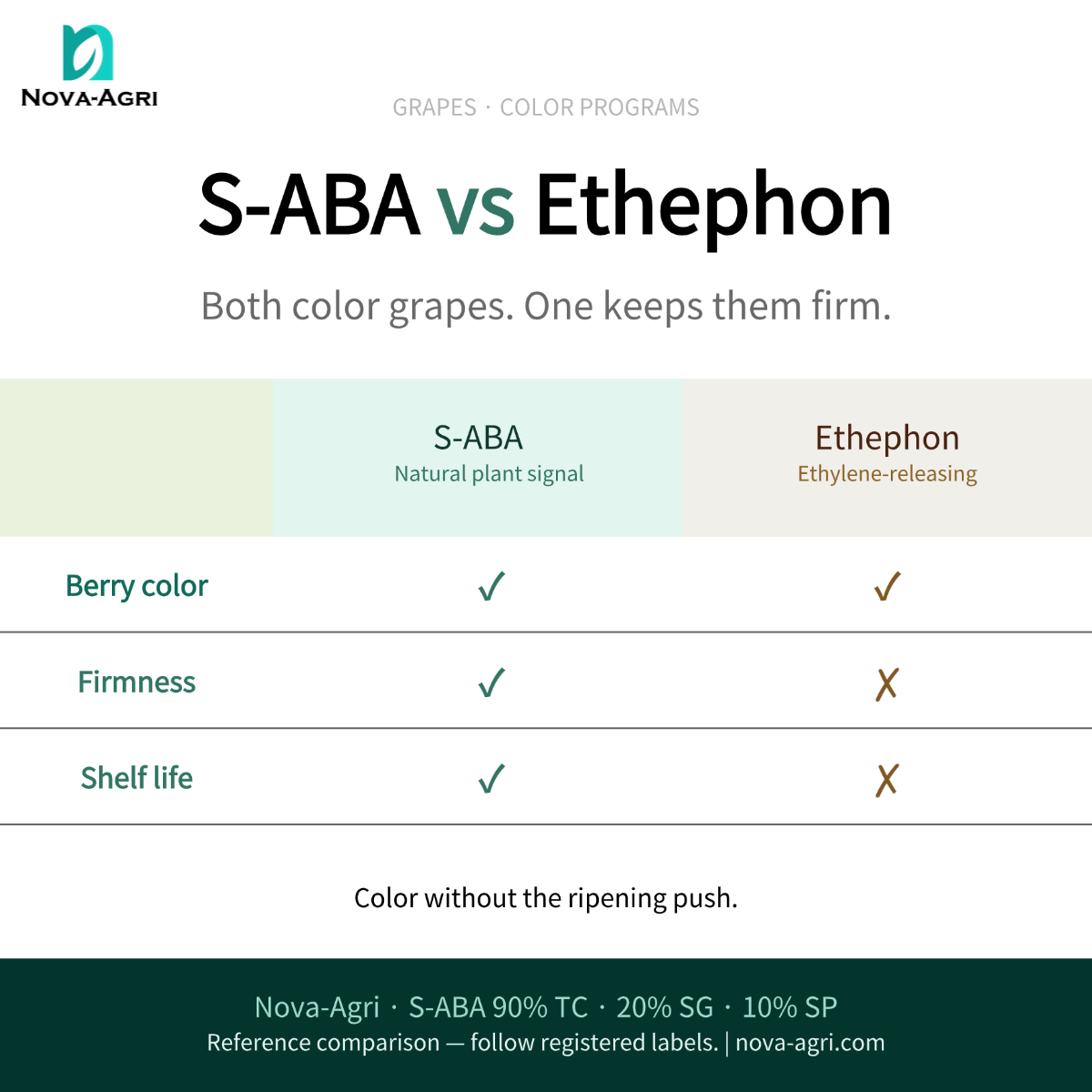
Both S-ABA and ethephon are used to color red table grapes — but they do different jobs. S-ABA (S-abscisic acid, CAS 21293-29-8) triggers the vine's own anthocyanin pathway without accelerating ripening, so berries stay firm and store well. Ethephon releases ethylene and accelerates ripening and color together, which can soften berries and raise residue considerations for export fruit. Many commercial programs use both, at different timings, for different objectives.
Disclaimer: All application rates referenced in this article are industry-typical reference ranges and rates reported in published research, not product labels. Actual use rates for any specific crop must be confirmed against the registered label in the target market. Nova-Agri accepts no liability for outcomes arising from the application of these reference rates.
Two different ways to get red berries
S-ABA is the plant's own color signal. At veraison, the berry's natural abscisic acid level rises and switches on the anthocyanin pathway: S-ABA signaling upregulates the MYB-bHLH-WD40 transcription complex, which activates the UFGT enzyme that converts anthocyanidins into the stable red pigments accumulated in berry skin. Sprayed S-ABA simply amplifies this natural signal — color develops faster and more uniformly, while maturity attributes (sugar, acidity, firmness) are essentially untouched. For a fuller explanation of the molecule and its other roles — stress tolerance, transplant shock, formulation — see our pillar guide: S-ABA (S-Abscisic Acid): What It Is and How It Works.
Ethephon (2-chloroethylphosphonic acid, CAS 16672-87-0) is an ethylene-releasing agent. Once absorbed by the plant it degrades to ethylene — the ripening hormone — which advances maturity as a whole: sugars accumulate, skin softens, and anthocyanins develop along with ripening. In table grapes it has been the industry-standard coloring tool for decades, particularly where a grower wants to advance harvest, not just color. It is a legitimate, low-cost tool — with a different job and a different risk profile than S-ABA.
S-ABA vs ethephon at a glance
S-ABA (CAS 21293-29-8) | Ethephon (CAS 16672-87-0) | |
Mode of action | Natural (+)-enantiomer of abscisic acid; switches on the vine's own anthocyanin (UFGT) pathway | Ethylene-releasing agent; accelerates overall ripening, color comes with it |
Color response | Uniform, concentration-dependent; no ripening push | Effective, but can be less uniform in warm climates |
Berry firmness | Maintained; trials report firmer berries than ethephon | Can reduce firmness and crispness (ripening effect) |
Sugar / acidity | Not significantly affected in published trials | Ripening advance raises Brix; may lower acidity |
Post-harvest behavior | Good storage and shelf-life performance | Softening and rachis issues possible in storage |
Residues (table grapes) | S-ABA exempt from residue tolerance where registered (e.g., US) | EU MRL 1 mg/kg on table grapes; Codex 0.8 mg/kg |
Organic production | The international reference product (ProTone®) is OMRI-listed and NOP-compliant | Synthetic PGR — not permitted in organic farming |
Application window | Veraison onward, including late-season use | Veraison to pre-harvest; timing critical to avoid softening |
Cost position | Higher cost per kg of a.i.; returns come from packout and fewer picks | Low cost per kg; quality risk sits at the packing line |
Best fit | Premium export fruit, firmness- and residue-sensitive programs, organic | Budget programs where ripening advance is also wanted |
What the published field trials show
Three independent trials compared the two directly on red table grapes:
Volcani Center, Israel (Lurie et al., 2010). On 'Crimson Seedless', S-ABA (ProTone®) was sprayed at 100, 200 and 400 mg/L at the beginning of veraison, alone and together with 500 mg/L ethephon. S-ABA colored berries in a concentration-dependent manner — 400 mg/L nearly doubled anthocyanin versus control — while ethephon alone enhanced color "to a lesser extent." Crucially for exporters: soluble solids, acidity, firmness and berry size were not affected by S-ABA.
UC Davis / CSIC (Cantín, Fidelius & Crisosto, 2007). Comparing the industry-standard 250 mg/L ethephon against 150 and 300 mg/L ABA on 'Crimson Seedless': both PGRs doubled packable yield by improving color, but ABA-treated grapes showed superior appearance of both berries and rachises, and marketable quality was reached 10–30 days earlier than untreated fruit. The authors concluded ABA is "an effective alternative to ethephon… maintaining postharvest quality."
Journal of Horticultural Science & Biotechnology (Amiri, Fallahi & Mirjalili, 2009). On 'Beidaneh Ghermez', berries treated with ABA were firmer than both the untreated control and ethephon-treated fruit — ethephon reduced berry firmness relative to control. Neither treatment affected yield; both increased anthocyanin linearly with rate.
The consistent picture across trials: S-ABA colors at least as well as ethephon at comparable or lower rates, does not advance ripening, and protects the firmness and post-harvest condition that export packers are paid for.
Residues, MRLs and organic production
For exporters, residues are often the deciding factor.
Ethephon is a regulated pesticide active with specific maximum residue limits: in the EU, the MRL for ethephon on table grapes is 1 mg/kg (wine grapes 2 mg/kg), with the Codex limit at 0.8 mg/kg (EFSA, 2024). These limits are manageable with good practice — but they add a residue-testing obligation to every export shipment.
S-ABA sits in a different regulatory category. The international reference product ProTone® (Valent BioSciences) is exempt from residue tolerance requirements in the US, with a zero-day pre-harvest interval, and has been OMRI-listed and NOP-compliant for organic production since 2010. S-ABA is a compound grapes produce naturally, which is why treated fruit shows no foreign residue of concern. Whether a specific S-ABA end product can be used in a certified organic program depends on that product's local registration and the grower's certifier — always confirm before spraying.
Note on registration. Nova-Agri is a raw-material supplier. Registration status of any PGR end product is country-specific and managed by the local formulator or importer. For customers registering S-ABA products, Nova-Agri provides the supporting documentation (COA, TDS, MSDS, impurity profile, physical-chemical data) for local dossiers.
Can S-ABA and ethephon be used together?
Yes — and this is more common than a head-to-head framing suggests. The Volcani trial sprayed S-ABA together with ethephon in the same program, and the ProTone® technical bulletin carries a dedicated "Use with Ethephon" section. Practical programs follow the objective:
Color-first objective: S-ABA at veraison onset. If color develops but harvest is not advancing, ethephon can follow later in the window.
Ripening-first objective: ethephon to advance maturity, with S-ABA used to clean up color uniformity on blocks where ethephon alone left green berries.
Sequential rather than tank-mixed is the safer default; respect each product's label timing, water volume and re-entry intervals, and note that S-ABA should not be tank-mixed with alkaline partners (pH > 8) and degrades in UV — spray in the evening or on overcast days.
Which one fits your program?
Your situation | The documented fit |
Premium export grapes, firmness and shelf life paid on | S-ABA at veraison |
Residue-sensitive or organic-certified production | S-ABA (confirm the end product's organic eligibility) |
Block that needs harvest advanced, not just color | Ethephon, or ethephon followed by S-ABA for uniformity |
Warm-climate 'Crimson Seedless' with chronic uneven color | S-ABA — the exact scenario in the three trials above |
Lowest possible input cost, fruit sold locally | Ethephon remains a legitimate, economical option |
For formulators: sourcing S-ABA technical material
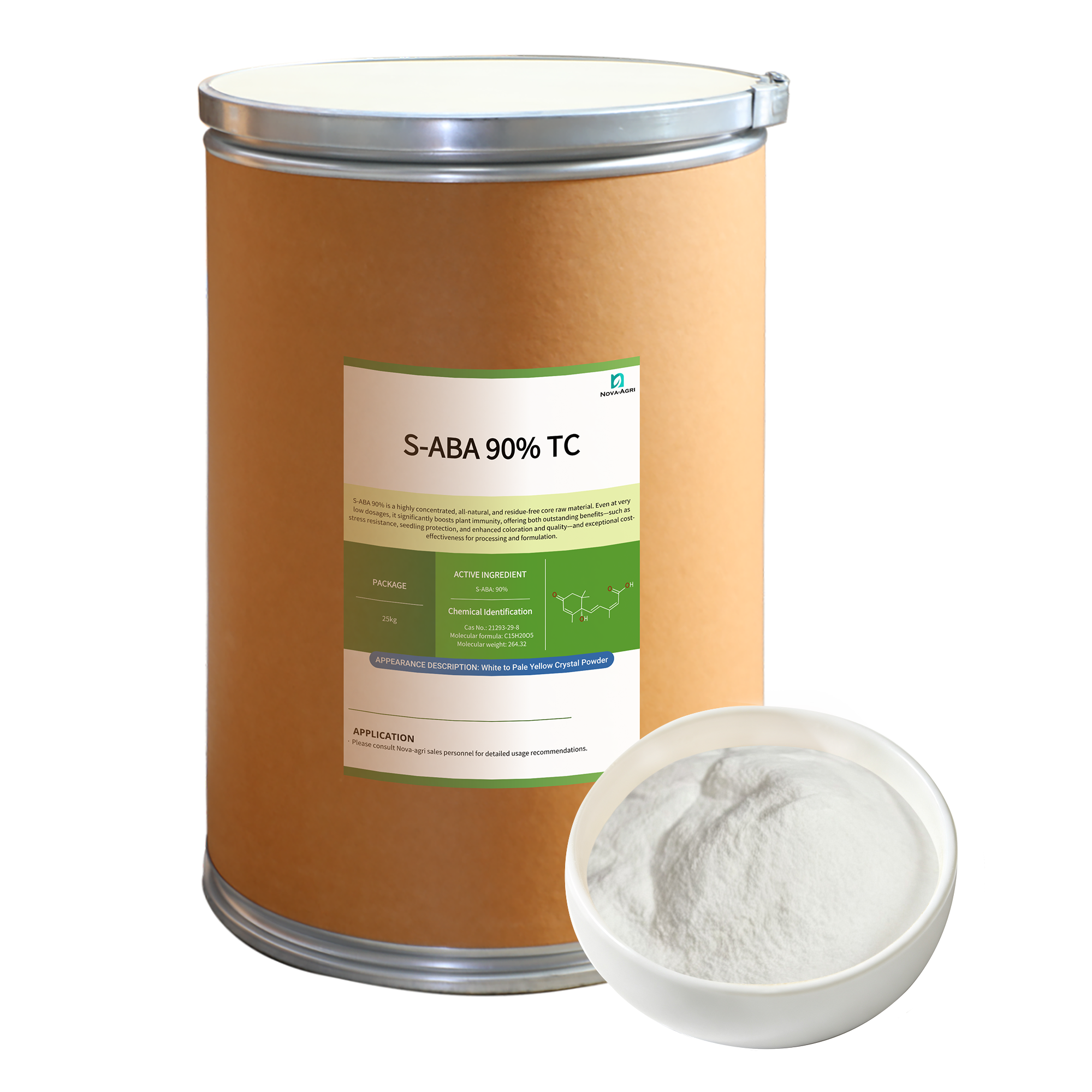
The market's familiarity with 20% SG and 10% SP-type S-ABA end products comes from the ProTone® formats — but the value chain starts with technical material. Nova-Agri supplies S-ABA (S-Abscisic Acid) 90% TC powder (the natural (+)-enantiomer produced by fermentation, not the much less active synthetic racemic mixture), 20% SG and 10% SP — with MOQ from 25 kg, delivery in about 10 working days to Shanghai port, OEM packaging and a batch COA for every shipment. Formulation notes and the full product specification are on the product page:
View S-ABA (S-Abscisic Acid) 90% TC Powder →
FAQ
Which is better for grape color, S-ABA or ethephon?
Neither is universally better. In published side-by-side trials on warm-climate 'Crimson Seedless', S-ABA produced stronger, more uniform color at comparable or lower rates without affecting firmness, sugar or acidity, while ethephon reduced firmness. Ethephon remains a legitimate and economical tool where advancing ripening is also an objective. The choice follows your market: firmness- and residue-sensitive export fruit favors S-ABA.
Can S-ABA and ethephon be used together?
Yes. Field research has tested S-ABA sprayed together with ethephon, and commercial programs commonly sequence them — for example S-ABA at veraison onset for color, ethephon later if ripening advance is needed. Follow each product's label for timing and precautions; avoid alkaline tank partners for S-ABA.
Does S-ABA affect sugar, acidity or berry firmness?
In published trials, no: soluble solids, titratable acidity, firmness and berry size were not significantly affected by S-ABA (Lurie et al., 2010), and one trial found ABA-treated berries firmer than both control and ethephon-treated fruit (Amiri et al., 2009). That ripening neutrality is the main reason exporters use it.
Is S-ABA allowed in organic grape production?
The international reference product ProTone® (Valent BioSciences) is OMRI-listed and NOP-compliant, and S-ABA is exempt from residue tolerance in the US. Whether a specific S-ABA end product can be used in certified organic production depends on that product's registration in your country and your certifier's approval — confirm both before use.
What rates are used for S-ABA and ethephon on table grapes?
As industry-typical reference ranges: S-ABA 25–100 mg/L a.i. sprayed on the clusters at the start of veraison (published trials tested 100–400 mg/L); ethephon 250–500 mg/L for coloring, with the exact rate and timing critical to avoid softening. Always confirm against the registered label in your market before application.
Where can formulators buy S-ABA technical material?
Nova-Agri supplies S-ABA (S-Abscisic Acid) 90% TC powder, 10% SP, 20% SG, etc., with MOQ from 25 kg, about 10 days to Chinese port, OEM packaging, batch COA and registration-support documentation (COA, TDS, MSDS, impurity profile).
References
Lurie, S., Lichter, A., Kaplunov, T., Zutahy, Y., Oren-Shamir, M., Ovadia, R. (2010). "Improvement of 'Crimson Seedless' grape colour by abscisic acid treatment." Journal of Horticultural Science & Biotechnology 85(3) — S-ABA 100–400 mg/L vs ethephon 500 mg/L side-by-side at veraison.
Cantín, C.M., Fidelibus, M.W., Crisosto, C.H. (2007). "Application of abscisic acid (ABA) at veraison advanced red color development and maintained postharvest quality of 'Crimson Seedless' grapes." Postharvest Biology and Technology 46(3), 237–241.
Amiri, M.E., Fallahi, E., Mirjalili, M.V. (2009). "Effects of abscisic acid or ethephon at veraison on the maturity and quality of 'Beidaneh Ghermez' grapes." Journal of Horticultural Science & Biotechnology 84(6), 660–664.
EFSA (2024). "Targeted review of the maximum residue levels (MRLs) for ethephon." EFSA Supporting Publications — EU MRL ethephon: table grapes 1 mg/kg, wine grapes 2 mg/kg.
Valent BioSciences Corporation. ProTone® technical bulletin — OMRI listing, exemption from residue tolerance, use-with-ethephon guidance.
The application rates in this article are general technical references drawn from published research. Always follow the registered product label and the regulations applicable in your country or region before any commercial application. This article is a technical comparison, not a superiority claim — ethephon and S-ABA are both legitimate tools with different jobs.
ProTone® is a registered trademark of Valent BioSciences Corporation (a subsidiary of Sumitomo Chemical Company). Its mention is for technical reference only and does not imply any affiliation, endorsement, partnership or distribution relationship between Nova-Agri and Valent BioSciences Corporation or Sumitomo Chemical Company.
Partner With Us
Interested in the products mentioned?
Contact our export team for availability and partnership opportunities.